
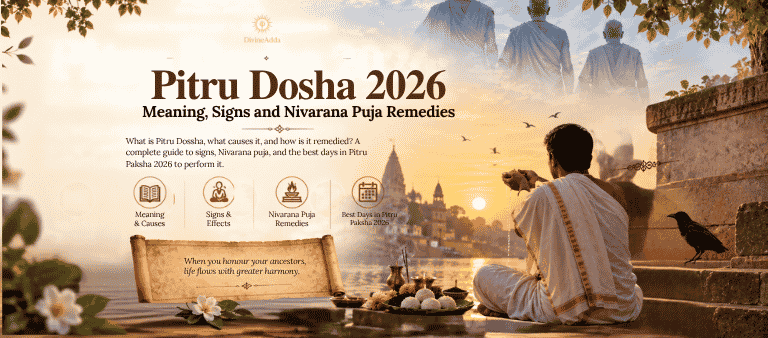
Pitru Dosha: What It Means, Common Signs, and How to Perform Nivarana Puja
Unexplained delays in marriage, career, or health are often blamed on Pitru Dosha — but what does that actually mean, and what does fixing it involve? A complete guide, timed to Pitru Paksha 2026.
What Pitru Dosha actually means
Pitru Dosha refers to an astrological affliction believed to arise when a family's ancestors (pitrs) are not honored properly — through neglected Shraddha rites, an ancestor's untimely or unnatural death, or unresolved rituals passed down unaddressed for generations. In Vedic astrology, it's read from specific planetary placements in a birth chart, most commonly Sun or Rahu/Ketu combinations involving the ninth house, which governs father, ancestry, and fortune.
It's important to separate the astrological concept from blanket superstition: Pitru Dosha isn't presented in tradition as a punishment, but as an unresolved obligation — the same idea explored in the Garuda Purana's teaching on Shraddha, where a soul's peace after death is treated as something the living family has an ongoing role in securing.
Common signs people associate with Pitru Dosha
Traditional and popular belief attributes a range of recurring life difficulties to Pitru Dosha, particularly when they appear without a clear alternate cause:
- Repeated, unexplained delays in marriage
- Persistent financial instability despite consistent effort
- Recurring health issues within the family, especially chronic or unexplained ones
- Difficulty conceiving, or repeated complications during pregnancy
- A pattern of family disputes or estrangement across generations
- A general sense of stagnation despite otherwise favorable circumstances
It's worth being clear-eyed here: none of these signs are exclusive to Pitru Dosha, and a birth chart reading from a qualified astrologer is the only reliable way to confirm whether Pitru Dosha is actually indicated — self-diagnosing from symptoms alone isn't how this is traditionally meant to work.
What causes it, according to tradition
A few specific circumstances are commonly cited as root causes:
- Neglected Shraddha — ancestors for whom the annual rites during Pitru Paksha have not been performed
- Unnatural or untimely death — an ancestor who died by accident, suicide, or in circumstances where proper last rites may not have been completed
- Curses or unresolved conflicts — disputes an ancestor left unresolved, particularly around land, inheritance, or family relationships
- Disrespect toward elders — a pattern of neglect toward living parents or grandparents, which tradition treats as connected to how ancestors are regarded after death, captured in the phrase Pitru Devo Bhava ("may your father be as a god to you") from the same body of teaching as Matru Devo Bhava ("may your mother be as a god to you")
Pitru Dosha Nivarana: how the remedy works
Nivarana simply means removal or remedy. The rituals used to address Pitru Dosha are largely the same ones performed during Pitru Paksha more broadly, applied with specific intent:
- Shraddha and Tarpan — performed on the ancestor's death anniversary tithi, or during Pitru Paksha, offering water, sesame seeds, and food in their name
- Pind Daan — the ritual offering of rice balls, often performed at specific tirthas
- Gaya Shraddha — Pind Daan performed specifically at Gaya in Bihar is considered the most complete and definitive remedy for Pitru Dosha in Hindu tradition, believed to grant the ancestor lasting peace in a way no other location can
- Reciting the Pitru Stotram, Pitru Gayatri Mantra, or Pitru Chalisa — devotional verses specifically addressed to ancestors, recited daily or during Pitru Paksha as an act of remembrance
- Feeding crows, cows, or Brahmins — a traditional offering made on behalf of ancestors, especially during Shraddha
- Donating food, clothes, or resources in an ancestor's name — particularly on their death anniversary or during the fortnight
When to perform Pitru Dosha remedies in 2026
While Tarpan and Shraddha can technically be performed on an ancestor's specific tithi throughout the year, Pitru Paksha is considered the single most effective window for Pitru Dosha remedies, since the fortnight is specifically set aside for ancestral rites. For the exact 2026 dates — including which tithi corresponds to which day, and the Kutup Muhurat timing to use — see our complete Shradh 2026: Start Date, End Date and Full Tithi Calendar. Sarva Pitru Amavasya, 10 October 2026, the final day of the fortnight, is specifically recommended for Pitru Dosha remedies when an ancestor's exact death date isn't known.
Is Pitru Dosha the same as Pitru Paksha?
No — they're related but distinct. Pitru Paksha is the annual fortnight (27 September–10 October in 2026) during which all families, regardless of chart placements, perform Shraddha for their ancestors. Pitru Dosha is a specific astrological affliction that may or may not be present in an individual's birth chart, and its remedies are typically more sustained and specific than the general rites performed during Pitru Paksha by everyone. The Mahabharata's own illustration of the underlying idea — devotion and generosity that never once extended to one's ancestors — is told in full in our Karna and Pitru Paksha origin story.
What this isn't meant to be
It's worth ending on the same note the Garuda Purana article makes: none of this is meant to function as a fear-driven checklist. Pitru Dosha, in its original framing, isn't a punishment mechanism — it's a way of naming what happens when a family relationship that tradition treats as ongoing gets treated as finished the moment someone dies. The remedy isn't really the ritual itself; it's the act of remembering deliberately, which the ritual just gives a specific, repeatable form.