
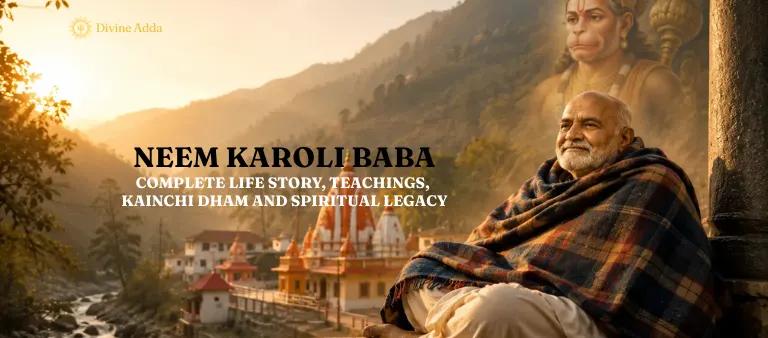
Neem Karoli Baba, lovingly remembered by his devotees as Maharajji, was an Indian spiritual teacher whose life became closely associated with devotion to Lord Hanuman, selfless service, compassion and remembrance of God. He lived a relatively simple life, yet the influence of his teachings eventually travelled far beyond the places where he spent his years.
Today, the name Neem Karoli Baba is strongly connected with Kainchi Dham in Uttarakhand, a Himalayan pilgrimage centre known for its Hanuman temple and ashram. His name is also closely associated with Vrindavan, where he spent the final period of his life. For many devotees, these places are not simply destinations but spaces connected with the memory, presence and teachings of Maharajji.
Interest in Neem Karoli Baba has grown across generations. Some people discover him through stories of Kainchi Dham. Others search for Neem Karoli Baba's history, his teachings, his connection with Hanuman, his ashrams, his family, the stories of his devotees or the experiences described as his chamatkar. His connection with Ram Dass also introduced his spiritual legacy to a much wider audience outside India.
This article looks at Neem Karoli Baba from several perspectives. It first examines what is known about his life, then looks at traditional accounts and stories preserved by devotees, followed by his teachings, Kainchi Dham, Ram Dass and the questions people commonly ask today.
Who Was Neem Karoli Baba?
Neem Karoli Baba was a Hindu spiritual teacher and a devoted follower of Lord Hanuman. His devotees affectionately called him Maharajji, a name that became almost as familiar as Neem Karoli Baba itself.

Accounts of his life commonly identify his birth name as Lakshman Narayan Sharma and associate his birth with Akbarpur in present-day Uttar Pradesh. His life is remembered through biographies, devotees, ashram traditions and personal accounts rather than through the kind of extensive public documentation available for a modern public figure.
He became known for his unusual spiritual presence and for the simple way in which he communicated with people. Rather than building his reputation around a large body of formal philosophical writing, much of what people remember about Maharajji comes from encounters with him, stories told by devotees and the spiritual communities that continued his work after his passing.
His devotion to Hanuman became one of the defining elements of his spiritual identity. The temples and centres associated with him therefore often place Hanuman devotion at the heart of their daily spiritual life.
Neem Karoli Baba is also remembered for his emphasis on love and service. The spiritual tradition surrounding him repeatedly returns to the idea that devotion should not remain limited to prayer. Helping others, feeding people, caring for those in need and living with compassion were also expressions of spiritual life.
Neem Karoli Baba History
The history of Neem Karoli Baba is best understood as a combination of biographical information and traditions preserved by his followers.
He is generally remembered as having been born in Uttar Pradesh and later becoming a wandering spiritual figure. Accounts of his early life differ in detail, and some popular biographies contain stories that are difficult to independently verify. For this reason, it is useful to distinguish between established biographical information and stories that belong to the devotional tradition.
During his spiritual journey, he became known by different names, including Baba Lakshman Das, before becoming widely recognised as Neem Karoli Baba or Maharajji. His life was not centred on establishing a conventional institution in the manner of a modern religious organisation. Instead, his influence developed through personal relationships, places where he stayed, temples and ashrams, and the people who regarded him as their teacher.
His connection with Kainchi in Uttarakhand became particularly important. Kainchi eventually developed into the place now known around the world as Kainchi Dham. The centre became closely associated with Hanuman worship and with the memory of Maharajji.
Another major chapter in his life was his connection with Vrindavan. The town, already deeply associated with Krishna devotion, became the place where Neem Karoli Baba spent his final days.
His passing in 1973 did not bring an end to his influence. Instead, devotees continued to maintain the places connected with him and to share his teachings and stories with new generations.
Neem Karoli Baba's Early Life and Spiritual Journey
Much of the popular interest in Neem Karoli Baba begins with the question of what led an ordinary young man from Uttar Pradesh toward a life of spiritual seeking.
Traditional accounts describe a life that gradually moved away from ordinary social expectations and toward spiritual discipline. Some biographies describe periods of wandering and renunciation, while other accounts emphasise his return to family life before his later spiritual work.
Because different biographies preserve different details, it is better to avoid presenting every traditional story as an exact historical record. What remains consistent across the broader tradition is the image of a man whose life became increasingly centred on spiritual practice, devotion and service.
His later identity as Maharajji was shaped not only by his own spiritual practices but also by the people who encountered him. Devotees described him as direct, unpredictable, affectionate, humorous and deeply compassionate. Many remembered that he could move quickly between ordinary conversation and spiritual instruction.
For people who met him, the teaching was often not a formal lecture. A meal, a conversation, a simple instruction or an unexpected act of kindness could become part of a devotee's understanding of spiritual life.
Why Is Neem Karoli Baba Famous?
Neem Karoli Baba became famous for several interconnected reasons.
First was his deep devotion to Lord Hanuman. Hanuman worship remains central to the spiritual atmosphere of Kainchi Dham and other places associated with Maharajji.
Second was his personal influence. People from very different backgrounds came to him seeking guidance, comfort or spiritual understanding. His devotees remembered his ability to make spiritual ideas practical rather than purely intellectual.
Third was the spread of his teachings through Ram Dass and other disciples. Richard Alpert, later known as Ram Dass, travelled to India in 1967 and met Neem Karoli Baba. That meeting became a major turning point in Alpert's life. His later work helped introduce Maharajji's spiritual influence to a large Western audience. :contentReference[oaicite:1]{index=1}
Finally, Kainchi Dham itself became a major pilgrimage centre. The combination of its mountain setting, Hanuman temple, ashram tradition and association with Maharajji has made it one of the best-known places connected with his name.
Neem Karoli Baba and Lord Hanuman
It is difficult to understand Neem Karoli Baba without understanding his devotion to Lord Hanuman.
Hanuman represents devotion, courage, humility, strength and selfless service. These same qualities are repeatedly associated with the teachings and life of Maharajji.
For Neem Karoli Baba's devotees, Hanuman was not simply a figure from a sacred story. Hanuman represented a way of living in which the ego becomes less important and service becomes more important.
This idea can be seen in the atmosphere of Kainchi Dham, where Hanuman worship is central. The temple tradition, prayers and devotional practices associated with the site continue to attract people who come specifically because of Maharajji's connection with Hanuman.
Some devotees go further and regard Neem Karoli Baba as having had a special or divine relationship with Hanuman. Such beliefs belong to the devotional tradition surrounding Maharajji and should be understood as matters of faith rather than presented as independently established historical facts.
What Did Neem Karoli Baba Teach?
One of the most remarkable aspects of Neem Karoli Baba's legacy is the simplicity of the teachings associated with him.
His spiritual message is often remembered through three broad ideas: love, service and remembrance of God.
Love Everyone
Love was central to the spiritual atmosphere created around Maharajji. Devotees remembered his ability to look beyond social differences and treat people with warmth and compassion.
For someone following this teaching today, love does not necessarily mean an emotional feeling toward everyone. It can mean choosing patience over anger, compassion over judgment and kindness over unnecessary conflict.
In this sense, spirituality becomes visible in everyday behaviour.
Serve Others
Seva, or selfless service, is another important theme associated with Neem Karoli Baba.
Service can take many forms. It can mean feeding someone who is hungry, helping a family member, supporting someone in difficulty, caring for an elderly person, volunteering at a temple or simply helping another person without expecting recognition.
The deeper idea is that spiritual practice should benefit more than the individual who performs it.
Remember God
Neem Karoli Baba's teachings also emphasised remembrance of God. Spiritual awareness was not meant to exist only inside a temple or during formal prayer.
A person could remember God while working, travelling, cooking, helping another person or dealing with an ordinary difficulty.
This makes the teaching particularly accessible. A person does not have to abandon family responsibilities or ordinary life to begin practising devotion.
Humility
Hanuman's example also provides an important lesson in humility. Strength without ego, knowledge without arrogance and service without the demand for praise are recurring themes in the spiritual tradition associated with Maharajji.
For devotees, this is one reason Hanuman became such a natural centre of Maharajji's spiritual life.
Kainchi Dham: The Most Famous Place Associated With Neem Karoli Baba
Kainchi Dham is the place most strongly associated with Neem Karoli Baba in the public imagination.
The ashram is located in the Kumaon region of Uttarakhand on the Nainital–Almora road. Uttarakhand Tourism describes Kainchi Dham as a Hanuman temple and ashram founded by Neem Karoli Baba and places it about 9 kilometres from Bhowali and 17 kilometres from Nainital. The tourism department also notes the distinctive shape of the surrounding hills, which resemble scissors and give the place its name. :contentReference[oaicite:2]{index=2}
The Uttarakhand Tourism Bhowali page also identifies Kainchi Dham as a Hanuman temple and ashram founded by Neem Karoli Baba and gives an early-1960s date for its establishment. :contentReference[oaicite:3]{index=3}
For devotees, however, Kainchi Dham is more than a location on a map.
It is a place associated with Maharajji's presence, Hanuman devotion, prayer and seva. People travel there to offer prayers, spend time in silence, receive darshan and remember the teachings of Neem Karoli Baba.
The natural surroundings also contribute to the atmosphere. The ashram lies in the hills of Kumaon, away from the noise of major cities. The journey itself can become part of the experience for visitors.
Why Is Kainchi Dham So Important?
Kainchi Dham became important because it combined several elements of Maharajji's spiritual life: Hanuman devotion, community, service and the presence of devotees.
Over time, the name of Kainchi Dham became inseparable from the name Neem Karoli Baba. People who had never met Maharajji began travelling to the place because of stories told by those who had.
The site also received attention because of visitors from outside India. Uttarakhand Tourism specifically mentions the association of Kainchi Dham with Steve Jobs and Mark Zuckerberg, which helped bring additional international attention to the pilgrimage centre. :contentReference[oaicite:4]{index=4}
That modern attention should not obscure the older devotional significance of the place. Kainchi Dham was important to Maharajji's followers before it became a destination discussed by international media.
Where Is Neem Karoli Baba Mandir?
When people search for “Neem Karoli Baba Mandir,” they are most commonly referring to the Hanuman temple and ashram at Kainchi Dham in Uttarakhand.
Kainchi Dham is located on the Nainital–Almora road in Uttarakhand. Uttarakhand Tourism lists it as approximately 9 kilometres from Bhowali and 17 kilometres from Nainital. :contentReference[oaicite:5]{index=5}
The location is surrounded by hills and is known for its peaceful environment. Travellers should nevertheless check current road conditions, local access rules and visiting arrangements before making a journey, particularly during the monsoon or other periods of difficult mountain weather.
Neem Karoli Baba Uttarakhand
The connection between Neem Karoli Baba and Uttarakhand is primarily centred on Kainchi Dham.
For many devotees, Uttarakhand is where the public pilgrimage tradition surrounding Maharajji feels most tangible. The mountain environment, Hanuman temple and ashram create a setting where visitors can spend time away from ordinary routines.
The area around Kainchi also has several other destinations in the Nainital and Kumaon region, making it possible for travellers to combine a spiritual visit with a wider journey through Uttarakhand.
Neem Karoli Baba Ashram
The word “ashram” is important when understanding Maharajji's legacy because his influence was preserved not only through individual memories but through places where devotees could continue spiritual practices.
Kainchi is the best-known centre associated with him. Vrindavan is another major place connected with his life and final years.

An ashram associated with a spiritual teacher is not simply a residence. It can become a living community where prayer, service, devotional activities and remembrance continue after the teacher's physical departure.
This is one reason Neem Karoli Baba's legacy has remained active for decades after his passing.
Neem Karoli Baba and Vrindavan
Vrindavan holds a special place in the final chapter of Neem Karoli Baba's life.
Known for its deep association with Krishna and Radha devotion, Vrindavan became the place where Maharajji spent the final period of his earthly life.
He passed away in Vrindavan on 11 September 1973. His samadhi became an important place of remembrance for devotees.
For followers, the significance of Vrindavan is therefore different from that of Kainchi Dham. Kainchi is remembered especially for the living ashram and Hanuman temple tradition associated with Maharajji, while Vrindavan is deeply connected with his final days and samadhi.
Neem Karoli Baba and Ram Dass
The relationship between Neem Karoli Baba and Ram Dass is one of the most important parts of the modern history of Maharajji's influence.
Ram Dass was born Richard Alpert and was a psychology professor at Harvard. In 1967, he travelled to India and met Neem Karoli Baba. The official Ram Dass archive describes Maharajji as his guru and identifies the 1967 journey as a decisive turning point in his life. :contentReference[oaicite:6]{index=6}
Ram Dass later became one of the most influential Western teachers associated with Indian spirituality. His experiences in India eventually contributed to the creation of Be Here Now, which was published in 1971. The book introduced meditation, yoga and Eastern spiritual ideas to a large Western audience. :contentReference[oaicite:7]{index=7}
Ram Dass himself described spending time with Maharajji between November 1967 and March 1968 and later explained how much of his transformation was connected with that period. :contentReference[oaicite:8]{index=8}
Because of Ram Dass, many people in the United States and other Western countries encountered the name Neem Karoli Baba for the first time.
How Neem Karoli Baba Influenced Ram Dass
Before meeting Maharajji, Richard Alpert was deeply involved in psychology and the exploration of consciousness. His meeting with Neem Karoli Baba shifted the direction of his life.
What he found in India was not simply another intellectual theory. The relationship with his guru introduced him to a devotional approach in which love, service, meditation and surrender became central.
Ram Dass later spent decades sharing what he had learned. Through books, talks, recordings and spiritual communities, the influence of his relationship with Maharajji continued long after Neem Karoli Baba's death.
This is an important reason Neem Karoli Baba's legacy is now both Indian and international.
Neem Karoli Baba's Devotees
Maharajji attracted people from very different backgrounds. Some came seeking spiritual guidance. Others came because of personal difficulties. Some were drawn by curiosity, while others arrived through recommendations from existing devotees.
His devotees included Indians and Westerners, householders and spiritual seekers, professionals and people living ordinary working lives.
The diversity of his followers reflects one of the central characteristics of his legacy: the teachings were not restricted to one social background.
The official Ram Dass archive continues to preserve stories and reflections from people who spent time with Maharajji. These accounts provide an important window into how devotees experienced him personally. :contentReference[oaicite:9]{index=9}
Neem Karoli Baba Ke Chamatkar
One of the most searched topics about Neem Karoli Baba is “Neem Karoli Baba ke chamatkar,” or stories of miracles associated with him.
There are many accounts in which devotees describe events they interpreted as extraordinary interventions, blessings or expressions of Maharajji's spiritual power.
These stories form an important part of the devotional tradition surrounding him. At the same time, they should be presented honestly. A devotee's experience can be deeply meaningful without becoming a scientifically verified historical event.
This distinction allows us to respect the faith of devotees while also maintaining editorial clarity.
A Devotee's Story of the Umbrella
The Ram Dass archive preserves a story concerning a devotee named R. P. Vaish and an umbrella given to him by Maharajji in 1967. According to the account, Baba instructed Vaish to keep the umbrella with him and described it as a form of protection.
Years later, when Vaish was suffering from serious health problems, his wife remembered the umbrella and placed it near him. The story says that subsequent medical examination showed a dramatic change in the condition of his spleen, which the family attributed to Maharajji's grace.
This is presented in the Ram Dass archive as a devotee account. It should therefore be understood as a spiritual testimony rather than as medical evidence that an umbrella caused a physical recovery. :contentReference[oaicite:10]{index=10}
Why Do Devotees Remember Such Stories?
For devotees, the significance of these stories is often not simply whether an extraordinary event can be proved. The stories represent faith, protection, surrender and the feeling that a spiritual teacher continues to care for those who trust him.
That emotional and devotional meaning is an important part of understanding why Neem Karoli Baba remains so deeply remembered.
Neem Karoli Baba and the Idea of Divine Grace
The word grace is frequently used when devotees speak about Maharajji.
Grace, in this context, refers to the feeling that something beyond ordinary personal effort has entered a person's life. For some devotees, this may be experienced through an unexpected solution to a problem. For another person, it may be a change in attitude, a new sense of courage or a deeper commitment to service.
Ram Dass's writings and talks frequently returned to the idea that his relationship with Maharajji transformed his understanding of love, service and spiritual awareness. :contentReference[oaicite:11]{index=11}
This is one reason the stories of Neem Karoli Baba continue to resonate even with people who approach them symbolically rather than literally.
Neem Karoli Baba's Family
Although Neem Karoli Baba became widely known as a spiritual teacher, accounts of his life also describe a period of family life.
Biographical sources commonly state that he had two sons and one daughter.
This part of his life is important because it shows that his legacy cannot be understood only through the image of a wandering saint. His story also included ordinary responsibilities and family relationships.
However, compared with the extensive devotional material surrounding his spiritual life, relatively less reliable public documentation is available about his family members. For this reason, DivineAdda should avoid publishing unverified names or personal details about his children simply because they appear on low-quality websites.
Neem Karoli Baba's Final Days
The final period of Maharajji's life is remembered through accounts from devotees who were with him during his last days.
Stories preserved by the Ram Dass archive describe his final days at Kainchi and the atmosphere among devotees. These accounts include prayers, kirtan, conversations and reflections from people who were close to him. :contentReference[oaicite:12]{index=12}
Neem Karoli Baba ultimately passed away in Vrindavan on 11 September 1973.
For devotees, this event is often referred to as Maharajji's mahasamadhi. The word carries a spiritual meaning within Indian traditions and reflects the way followers understand the passing of a realised teacher.
For a general historical article, however, it is useful to state the straightforward fact as well: Neem Karoli Baba died in 1973 in Vrindavan.
What Happened to Neem Karoli Baba After His Death?
His physical death did not end the growth of his spiritual legacy.
Devotees continued to visit Kainchi Dham and Vrindavan. Ashrams and temples associated with his tradition continued to serve visitors. Books, personal memories and later spiritual teachers helped preserve stories of Maharajji for new generations.
The spread of his teachings through Ram Dass also meant that people outside India continued discovering his name decades after his passing.
Today, a person can encounter Neem Karoli Baba through a pilgrimage to Kainchi Dham, a book by Ram Dass, a devotee story, a temple or a simple teaching about love and service.
Why People Still Visit Kainchi Dham
People visit Kainchi Dham for many different reasons.
Some are devoted to Hanuman. Some have read about Maharajji and want to visit the place most closely associated with him. Some arrive after hearing stories from family members or friends. Others simply want a quiet place for prayer and reflection.
The physical setting is also part of the attraction. The temple and ashram are situated among the hills of Kumaon, creating an environment very different from the crowded atmosphere of India's major cities.
Government tourism information describes Kainchi Dham as a popular pilgrimage centre and notes its location between two hills. :contentReference[oaicite:13]{index=13}
For a devotee, however, the meaning of the journey is usually deeper than sightseeing. The visit becomes an opportunity to remember Maharajji, pray to Hanuman and reflect on the values of love and service.
Neem Karoli Baba Mandir Jaipur
Another common search is “Neem Karoli Baba Mandir Jaipur.” People also search specifically for “Neem Karoli Baba Mandir Mansarovar.”
These searches should be handled carefully because a local temple or spiritual centre associated with Neem Karoli Baba should not automatically be treated as the same place as Kainchi Dham.
Kainchi Dham is the famous Neem Karoli Baba ashram and Hanuman temple in Uttarakhand. Local temples in Jaipur may have their own history, management and relationship with Maharajji's devotional tradition.
If you are planning to visit a Neem Karoli Baba-related temple in Jaipur or Mansarovar, verify the current address, opening hours and local information before travelling.
Neem Karoli Baba Distance From Jaipur
The answer to the search “Neem Karoli Baba distance from Jaipur” depends on which Neem Karoli Baba centre you want to visit.
Kainchi Dham in Uttarakhand is a different destination from the Neem Karoli Baba centre in Vrindavan. The road distance, travel time and route from Jaipur therefore depend on the destination selected.
Because road routes and travel conditions can change, travellers should use a current map service when planning their journey rather than relying on an old fixed distance published online.
Neem Karoli Dham Kahan Par Hai?
If someone asks, “Neem Karoli Dham kahan par hai?” the most common answer is Kainchi Dham in Uttarakhand.
Kainchi Dham is located on the Nainital–Almora road, near Bhowali and Nainital. Uttarakhand Tourism lists the centre approximately 9 kilometres from Bhowali and 17 kilometres from Nainital. :contentReference[oaicite:14]{index=14}
There is also a major Neem Karoli Baba connection in Vrindavan, where his samadhi is located. Therefore, people searching for “Neem Karoli Baba kahan par hai” may be asking about either the famous Kainchi Dham pilgrimage centre or the Vrindavan centre.
Neem Karoli Baba History in Hindi
For Hindi-speaking readers, the history of Neem Karoli Baba can be understood through a simple story of devotion, service and spiritual influence.
Neem Karoli Baba, जिन्हें उनके भक्त महाराजजी के नाम से भी याद करते हैं, भगवान हनुमान के महान भक्त माने जाते हैं। उनका जीवन उत्तर प्रदेश से शुरू होकर उत्तर भारत के कई आध्यात्मिक स्थानों से जुड़ा और बाद में उत्तराखंड का कैंची धाम उनके नाम से विशेष रूप से प्रसिद्ध हुआ।
उनकी शिक्षाओं में प्रेम, सेवा, भक्ति और ईश्वर का स्मरण महत्वपूर्ण माने जाते हैं। उनके भक्तों द्वारा सुनाई गई अनेक घटनाएं आज भी उनके आध्यात्मिक प्रभाव की याद दिलाती हैं।
राम दास जैसे शिष्यों के माध्यम से महाराजजी की शिक्षाएं भारत के बाहर भी पहुंचीं और आज दुनिया के अलग-अलग हिस्सों में लोग उनके जीवन और संदेश के बारे में जानना चाहते हैं।
Neem Karoli Baba Movie
“Neem Karoli Baba movie” and “Neem Karoli Baba movie name” are increasingly common searches because many people want to see his life presented through cinema or documentary storytelling.
A film about a spiritual figure like Maharajji has a difficult responsibility. His life includes documented events, traditional stories and deeply personal devotee experiences. A responsible film should distinguish between these different layers rather than presenting every devotional story as historical fact.
Because film projects can change during production and distribution, readers should verify any reported movie title, cast or release date through an official production or distribution announcement.
Neem Karoli Baba and Modern Spirituality
The continued interest in Neem Karoli Baba shows how spiritual teachings can travel across time and culture.
Maharajji lived in a very different India from the one that exists today. Yet people now discover him through websites, books, social media, videos, podcasts and online communities.
What remains attractive is the simplicity of his message. Modern life can be complicated, but love, kindness and service are understandable in almost every culture.
This may be one reason his teachings continue to attract people who are not necessarily looking for a complicated religious philosophy.
What Makes Neem Karoli Baba's Teachings Different?
Neem Karoli Baba did not become widely known because of a large written philosophical system. His influence grew through relationships and lived experience.
A person might remember something he said. Another person might remember being fed at the ashram. Someone else might remember a moment of kindness. Another devotee might remember a story they considered miraculous.
These individual memories collectively created a spiritual legacy.
This is why studying Neem Karoli Baba requires more than looking for one official biography. His story exists at the meeting point of biography, oral tradition, personal experience and continuing devotional practice.
Neem Karoli Baba's Spiritual Legacy
The spiritual legacy of Neem Karoli Baba is preserved through several connected traditions.
Kainchi Dham remains the most visible physical centre associated with him. Vrindavan preserves the memory of his final days and samadhi. Ram Dass's writings brought his influence to millions of Western readers. Devotee stories continue to circulate through books and online archives.
The legacy is therefore both local and global.
Someone may visit Kainchi Dham because they grew up hearing about Maharajji. Someone else may discover him through Be Here Now. Another person may encounter his name while searching for Hanuman devotion.
Despite these different entry points, the central themes remain remarkably consistent: love, service, devotion and remembrance of God.
Frequently Asked Questions About Neem Karoli Baba
Who was Neem Karoli Baba?
Neem Karoli Baba, also known as Maharajji, was an Indian Hindu spiritual teacher and devotee of Lord Hanuman. He became closely associated with Kainchi Dham in Uttarakhand and with spiritual communities in places including Vrindavan.
What was Neem Karoli Baba's real name?
His birth name is commonly given as Lakshman Narayan Sharma. He was later known by names including Baba Lakshman Das, Neem Karoli Baba and Maharajji.
Why is Neem Karoli Baba famous?
He is famous for his devotion to Lord Hanuman, his teachings on love and selfless service, Kainchi Dham and the many devotees who preserved stories about his life. His influence also became international through Ram Dass.
Where is Neem Karoli Baba Mandir located?
The most famous temple and ashram associated with Neem Karoli Baba is Kainchi Dham in Uttarakhand, on the Nainital–Almora road near Bhowali and Nainital.
Where is Neem Karoli Dham?
Kainchi Dham, the best-known pilgrimage centre associated with Neem Karoli Baba, is in Uttarakhand. The name Neem Karoli Baba is also associated with a major centre in Vrindavan.
What is Kainchi Dham famous for?
Kainchi Dham is famous as a Hanuman temple and ashram founded by Neem Karoli Baba. It became an important pilgrimage centre for his devotees and later gained international attention through visitors and followers from outside India.
What are the main teachings of Neem Karoli Baba?
The teachings associated with Maharajji emphasise love, selfless service, compassion, devotion and remembering God. His message is often expressed in simple practical terms rather than through a complicated philosophical system.
Was Neem Karoli Baba a devotee of Hanuman?
Yes. Devotion to Lord Hanuman is one of the central characteristics of Neem Karoli Baba's spiritual legacy. The Hanuman temple at Kainchi Dham is an important part of that connection.
Who was Ram Dass to Neem Karoli Baba?
Ram Dass, born Richard Alpert, was an American psychologist who travelled to India in 1967 and met Neem Karoli Baba. He regarded Maharajji as his guru and later helped introduce his spiritual influence to a large Western audience. :contentReference[oaicite:15]{index=15}
When did Ram Dass meet Neem Karoli Baba?
Ram Dass met Neem Karoli Baba during his journey to India in 1967. The meeting became a major turning point in his spiritual life. :contentReference[oaicite:16]{index=16}
When was Be Here Now published?
Be Here Now was published in 1971. The book became an important work in the spread of meditation, yoga and Eastern spiritual ideas among Western readers. :contentReference[oaicite:17]{index=17}
What are Neem Karoli Baba's chamatkar?
Devotees have preserved many stories of extraordinary experiences that they regard as miracles or blessings from Maharajji. These should be understood as devotional accounts and personal experiences rather than as scientifically established events.
Did Neem Karoli Baba perform miracles?
Many devotees believe that Neem Karoli Baba performed or was associated with extraordinary events. Such stories form an important part of his devotional tradition. However, individual miracle accounts should be presented as reports or experiences of devotees rather than as independently verified historical facts.
How many children did Neem Karoli Baba have?
Biographical accounts commonly state that Neem Karoli Baba had two sons and one daughter. Detailed personal information about his family should be treated carefully unless supported by reliable sources.
When did Neem Karoli Baba die?
Neem Karoli Baba passed away on 11 September 1973 in Vrindavan.
Where is Neem Karoli Baba's samadhi?
Neem Karoli Baba's samadhi is in Vrindavan, Uttar Pradesh. Vrindavan therefore remains an important pilgrimage destination for his devotees.
Is Neem Karoli Baba Mandir in Jaipur?
There are searches for Neem Karoli Baba-related temples and centres in Jaipur, including Mansarovar. These local places should not automatically be confused with the famous Kainchi Dham in Uttarakhand. Visitors should verify the current local address before travelling.
How far is Neem Karoli Baba Mandir from Jaipur?
The answer depends on the destination. Kainchi Dham in Uttarakhand and the Neem Karoli Baba centre in Vrindavan are different locations. The current road distance should be checked using a live map before travelling.
Is there a Neem Karoli Baba movie?
There is strong public interest in films and documentaries about Neem Karoli Baba. Because movie projects and release schedules can change, any reported title or release date should be confirmed through an official production or distribution source.
What Can We Learn From Neem Karoli Baba Today?
Perhaps the most enduring part of Neem Karoli Baba's legacy is that his teachings can be applied without requiring a person to live like a renunciant.
A person can practise kindness at home. A person can serve someone who needs help. A person can remember God while working. A person can pray to Hanuman with sincerity. A person can try to reduce anger and increase compassion.
These practices may appear simple, but simplicity is part of what made Maharajji's message powerful.
His life also reminds us that spiritual influence does not always come from books or institutions. Sometimes it develops through relationships and the memories people carry from one person to another.
Neem Karoli Baba: A Legacy of Love and Service
Neem Karoli Baba's story is not only the story of one saint or one ashram. It is also the story of how a spiritual teacher's influence can continue through people.
At Kainchi Dham, devotees remember Maharajji through Hanuman worship and service. In Vrindavan, they remember him at his samadhi. Through Ram Dass, his influence reached readers and seekers across the world. Through countless personal stories, devotees continue to describe how they felt changed by their encounters with him.
Some stories belong to documented history. Others belong to traditional remembrance. Still others are deeply personal experiences that cannot be independently verified.
All of these layers are part of understanding why Neem Karoli Baba remains such a powerful spiritual figure.
For those who approach his life through faith, Maharajji may be remembered as a saint whose presence continues through devotion. For those approaching him historically, he remains an influential twentieth-century Indian spiritual teacher whose legacy reached far beyond his immediate surroundings.
And for anyone simply looking for a practical spiritual message, the teachings associated with Neem Karoli Baba remain remarkably straightforward: love, serve and remember God.
Final Thoughts
Neem Karoli Baba remains one of the most recognisable Indian spiritual teachers associated with modern Hanuman devotion. His connection with Kainchi Dham made the Himalayan ashram a major pilgrimage destination, while his relationship with Ram Dass helped carry his influence across cultural and geographical boundaries.
His story contains many different layers. There is the historical person, the spiritual teacher remembered by disciples, the traditional stories preserved by devotees and the modern figure discovered by millions through books, websites and social media.
Understanding those layers allows us to appreciate Neem Karoli Baba without reducing his life either to a collection of miracles or to a dry biography.
His physical life ended in Vrindavan in 1973, but his spiritual legacy continues at Kainchi Dham, Vrindavan and in the lives of people who continue to practise the values associated with him.
For DivineAdda readers, perhaps the most meaningful way to remember Neem Karoli Baba is through the simplicity of the values connected with his life: love without unnecessary boundaries, service without expectation, devotion without pride and remembrance of God in everyday life.