
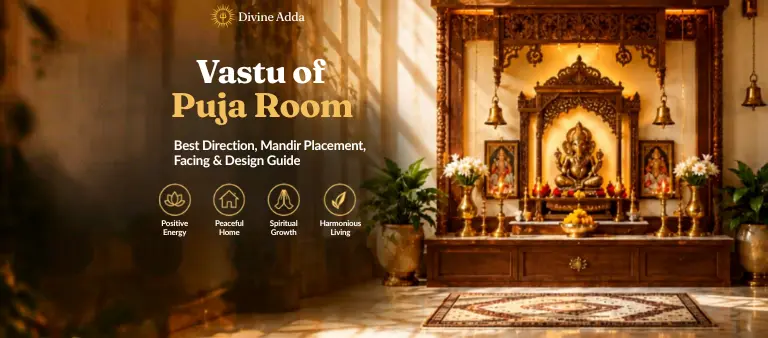
Vastu of Puja Room: Best Direction, Mandir Placement, Facing & Design Guide
A Puja Room or Pooja Mandir is more than a designated place for prayer in an Indian home. For many families, it is the spiritual centre of the household—a space where people light a diya, offer flowers, chant mantras and begin or end the day with prayer.
This is why questions such as “Which direction should a mandir face?”, “What is the best direction for a mandir in home?”, “Where should a pooja room be placed?” and “What does Vastu Shastra say about a home mandir?” are so common.
According to traditional Vastu Shastra, the placement, orientation and design of spaces are considered in relation to the directional layout of a home.
Among all the questions surrounding Puja Room Vastu, the most commonly discussed is the northeast direction, traditionally associated with spiritual activities and known as Ishanya.
However, direction is only one part of the picture.
The room's location, entrance, deity placement, cleanliness, ventilation, natural light, proportions and practical usability should also be considered.
In this guide, DivineAdda explains the traditional Vastu of Puja Room, including the best mandir direction, placement, idol facing, colours, size, design and common mistakes.
Important: Vastu Shastra is a traditional Indian architectural and spatial practice. Its recommendations are matters of cultural and spiritual belief and should not be treated as scientifically established guarantees of health, wealth or future outcomes.
What Is Vastu of Puja Room?
Puja Room Vastu refers to traditional Vastu principles used to decide where and how a prayer space or mandir should be arranged within a home.
The main considerations traditionally include:
- Direction of the Puja Room
- Position of the mandir
- Direction in which the deity faces
- Direction in which the worshipper faces
- Placement of the entrance
- Height and position of the altar
- Natural light and ventilation
- Colours and materials
- Cleanliness
- Distance from unsuitable spaces
The goal, according to the traditional framework, is to create a calm and spiritually suitable environment for prayer and meditation.
What Is the Best Direction for a Mandir at Home?

If you are searching for “best direction for mandir”, “mandir direction as per Vastu” or “mandir should be in which direction,” the northeast direction is traditionally considered the preferred location for a Puja Room.
The northeast is known as Ishanya direction in Vastu traditions.
It is traditionally associated with:
- Spirituality
- Prayer
- Meditation
- Purity
- Divine awareness
This is why north east direction appears as an important related search query in the uploaded data.
However, a practical home may not always allow a dedicated northeast Puja Room.
In such cases, the entire house layout should be considered rather than forcing a mandir into an unsuitable or inconvenient location.
Mandir Direction as per Vastu: Which Direction Is Best?
The question “mandir direction according to Vastu” can mean two different things:
- Where should the Puja Room or mandir be located?
- Which direction should the deity face?
These should not be confused.
Traditional preference for location
Northeast / Ishanya is commonly preferred for a Puja Room.
For deity orientation
Traditional practices often recommend arranging the altar so that the worshipper can sit facing an auspicious direction during prayer.
The exact arrangement can vary depending on:
- Deity
- Home layout
- Mandir design
- Tradition followed
- Available space
Therefore, there is no need to treat a single orientation rule as universally applicable to every home.
Mandir Ki Disha: Which Direction Should the Mandir Be in?
If you search “mandir ki disha” or “mandir kis disha me hona chahiye,” you will find many different recommendations.
For a general Vastu-based home arrangement:
Northeast
Traditionally considered the first preference for a Puja Room.
East
Often considered suitable for prayer because of its association with the rising Sun and morning worship.
North
May also be considered in some traditional layouts depending on the home plan.
Other Directions
If northeast, east or north is unavailable, don't compromise the basic functionality of the home merely to follow a rigid rule.
A clean, peaceful and dedicated prayer area that fits naturally into the house can be more practical than an inconvenient placement.
Where Should a Puja Room Be Located in the House?
The search query “pooja room vastu” specifically reflects interest in the placement of the prayer room.
Traditionally, the following hierarchy is commonly discussed:
1. Northeast — preferred
2. East — commonly considered suitable
3. North — may be considered depending on layout
The exact recommendation can vary according to the architectural plan and Vastu tradition being followed.
A Vastu-based decision should therefore consider the whole floor plan, rather than one direction in isolation.
Vastu for Home Mandir in Apartments
Modern apartments create a different challenge.
You may not have:
- A separate Puja Room
- A large northeast corner
- Freedom to change walls
- A perfectly aligned floor plan
That doesn't mean you cannot create a meaningful prayer space.
A compact mandir can be placed in a clean and peaceful part of the home while maintaining practical considerations.
For apartments, focus on:
- A dedicated prayer area
- Cleanliness
- Adequate ventilation
- Natural or soft lighting
- A stable altar
- Comfortable sitting space
- Avoiding clutter
- Keeping the mandir away from direct disturbance
If a dedicated room isn't possible, a properly designed home mandir can work within the available space.
Mandir Position as per Vastu

The mandir position should ideally allow the space to remain peaceful and uncluttered.
Traditional Vastu guidance generally discourages placing the mandir where it becomes an extension of a storage area.
Avoid turning the prayer space into a place for:
- Unused boxes
- Household clutter
- Random decorative objects
- Cleaning supplies
- Broken items
A mandir should have visual and physical separation from unnecessary household activity wherever possible.
Where Should You Avoid Placing a Puja Room?
Traditional Vastu guidance commonly recommends avoiding certain locations for a Puja Room when alternatives are available.
Avoid cluttered spaces
A prayer space should not be surrounded by unnecessary objects.
Avoid directly beside a toilet
Traditionally, placing the mandir immediately adjacent to or sharing a wall with a toilet is generally discouraged.
Avoid inside the bedroom when possible
A dedicated prayer area is traditionally preferred over keeping the mandir inside a bedroom.
Avoid under a staircase
Many Vastu traditions discourage using the space directly beneath a staircase as the primary prayer area.
Avoid unstable or temporary placement
The altar should be secure and appropriately positioned.
These are traditional Vastu recommendations, not scientific requirements.
Pooja Room Facing: Which Way Should You Face While Praying?
“Mandir facing direction” and “pooja room facing direction” are frequently searched because people want to know how the altar and worshipper should be oriented.
Traditionally, facing east while praying is commonly recommended.
North-facing prayer is also discussed in many Vastu traditions.
The exact setup can depend on the deity, altar arrangement and room geometry.
Rather than focusing only on compass direction, ensure that:
- You can sit comfortably
- The deity is visible
- The altar is stable
- The room receives adequate light
- The area remains clean
- Prayer can be performed without disturbance
Vastu Pooja Room Idol Facing Direction

The placement of idols is one of the most sensitive parts of Puja Room Vastu.
Traditional practices differ depending on the deity and regional tradition.
For a general home mandir:
- Keep idols securely placed.
- Avoid excessive numbers of large idols in a very small altar.
- Keep the idols clean.
- Don't place broken idols or damaged religious objects in the active worship area.
- Maintain enough space around the idols for offerings and prayer.
- Avoid placing idols directly on the floor.
The exact orientation of individual deities should be considered according to the specific tradition you follow rather than applying one universal rule to every deity.
How High Should a Puja Mandir Be?
There is no single universally applicable measurement across all Vastu traditions.
However, the practical principle is simple:
The altar should be at a comfortable and respectful height for daily worship.
A wall-mounted mandir should be securely installed.
A floor-standing mandir should have enough elevation that the idols are not placed directly on the floor.
The design should also leave enough room for:
- Diya
- Incense
- Flowers
- Water
- Prasad
- Other daily worship items
Pooja Room Size as per Vastu
People often search for “pooja room size” because they assume there is one perfect measurement.
There isn't one universal size that works for every house.
A Puja Room should be proportionate to the home.
Small apartment
A compact wall-mounted or cabinet-style mandir may be sufficient.
Medium home
A dedicated prayer niche or small room can provide additional space for sitting and worship.
Large home
A separate Puja Room can accommodate a larger altar and comfortable seating.
The most important practical considerations are:
Proportion + cleanliness + accessibility + ventilation + peaceful atmosphere.
Best Colour for Puja Room as per Vastu

Colour recommendations vary between Vastu traditions, but lighter shades are commonly preferred for prayer spaces.
Suitable traditional choices can include:
- White
- Cream
- Light yellow
- Light beige
- Soft earthy tones
The purpose is to create a calm visual environment.
Avoid making a small Puja Room excessively dark or visually crowded.
Natural light can also improve the atmosphere of the space.
Pooja Room Lighting and Diya
Lighting has an important role in the spiritual atmosphere of a Puja Room.
A traditional home mandir may include:
- Diya
- Oil lamp
- Soft ambient lighting
- Natural daylight
Make sure lamps and diyas are placed on a stable, heat-resistant surface and kept away from curtains, paper and other combustible materials.
A clean and well-lit prayer area is both spiritually meaningful and practically safer.
Puja Room Ventilation
A Puja Room should not become a completely enclosed, poorly ventilated space.
Incense and lamps can produce smoke and particles.
Therefore:
- Provide ventilation where possible.
- Allow fresh air into the room.
- Avoid excessive incense in a closed space.
- Keep the room clean.
- Use ventilation particularly if the mandir is inside a small apartment.
Good ventilation is a practical household consideration, independent of Vastu beliefs.
Mandir Design for Home

Searches for “mandir design” and “mandir design for home” show that users are also interested in how the prayer space should look.
Modern home mandir designs can include:
Wall-mounted Mandir
Ideal for apartments and compact homes.
Wooden Mandir
A traditional-looking option that can create a warm atmosphere.
Marble Mandir
Often chosen for larger permanent prayer spaces.
Jaali Mandir
Decorative screens can create visual separation without making a small space feel closed.
Minimalist Mandir
A simple shelf, backdrop and lighting can create a clean modern prayer area.
The best design is one that remains easy to clean and doesn't compromise the spiritual purpose of the space.
Ghar Mein Mandir Ka Vastu: 10 Practical Rules
If you are specifically searching “ghar me mandir ka vastu,” start with these practical principles:
1. Prefer Northeast
Traditionally, northeast is considered the preferred location.
2. Keep the Space Clean
A mandir should not become a storage area.
3. Provide Natural Light
Natural light can make the room feel peaceful and welcoming.
4. Maintain Ventilation
Especially important when using incense or lamps.
5. Keep Idols Secure
Don't place idols precariously on shelves.
6. Avoid Broken Religious Objects
Damaged idols and worship items should be handled respectfully according to your tradition.
7. Don't Overcrowd the Altar
Give each deity sufficient visual and physical space.
8. Choose Calm Colours
Light, soothing colours are commonly preferred.
9. Keep Prayer Items Organized
Store incense, diyas, flowers and other items neatly.
10. Prioritize Daily Usability
A beautiful mandir that is difficult to access or maintain is not practical.
Can a Mandir Be in the Southeast Direction?
The search data specifically shows rising interest in “mandir in south east direction”, with a 90% increase in the uploaded dataset.
This is an important question because many homes don't have a suitable northeast space.
Traditional Vastu recommendations can differ depending on the layout and school of Vastu being followed.
Therefore, don't conclude that a southeast mandir automatically causes a particular problem.
Instead, evaluate:
- Exact room position
- Entrance
- Kitchen placement
- Bedroom placement
- Toilet location
- Floor plan
- Directional orientation
- Deity arrangement
For a home-specific assessment, a complete floor plan is more useful than applying one isolated internet rule.
How to Check Mandir Direction Using a Compass
The uploaded search data shows strong interest in compass, compass direction, direction compass, compass online and vastu compass.
You can use a compass to identify the approximate orientation of your home.
Simple method
- Stand near the centre of the room.
- Hold the compass horizontally.
- Identify North.
- Mark the remaining directions.
- Locate Northeast, East, Southeast, South, Southwest, West and Northwest.
- Compare the mandir's location with the floor plan.
For greater accuracy, use the compass away from large metal objects and electronic interference.
Remember that a compass tells you direction; it does not itself determine whether a complete home complies with Vastu.
Vastu Compass: Why Direction Alone Isn't Enough
A common mistake is to think:
“My mandir is in the northeast, therefore everything is perfect.”
Vastu analysis is traditionally more comprehensive.
It can consider:
- Direction
- Plot shape
- Room arrangement
- Entrances
- Proportions
- Open spaces
- Kitchen
- Bedrooms
- Bathrooms
- Staircases
- Mandir
- Other structural elements
Therefore, direction is a starting point, not a complete Vastu assessment.
Vastu Shastra Ke Anusar: Creating a Peaceful Puja Space
If you are searching “Vastu Shastra ke anusar,” remember that Vastu is fundamentally about the relationship between built space, orientation and traditional concepts of balance.
For a Puja Room, the spiritual objective can be supported by simple habits:
Clean the space regularly.
Keep the altar organized.
Use the room for prayer and meditation rather than storage.
Allow adequate light and ventilation.
Create enough space for comfortable prayer.
Maintain a peaceful atmosphere.
These practices make the room meaningful regardless of the exact architectural layout.
Vastu Dosha in Puja Room: Should You Worry?
The term Vastu Dosh is commonly used when a home is believed to have an imbalance according to a particular Vastu system.
Online discussions sometimes make alarming claims such as:
“Your mandir is in the wrong direction, so something bad will happen.”
Such claims should be treated cautiously.
Vastu is a traditional system, and there is no scientific basis for guaranteeing that a particular room direction will cause a specific event.
If you are concerned about your home layout, focus on practical improvements first:
- Reduce clutter
- Improve ventilation
- Increase natural light
- Fix damaged structures
- Keep the Puja Room clean
- Improve organization
- Create a peaceful prayer environment
Puja Room Vastu for Small Homes
Not everyone has a separate prayer room.
If you live in a small apartment, consider:
Option 1: Wall-mounted Mandir
Uses vertical space.
Option 2: Dedicated Prayer Niche
A small architectural niche can visually separate the mandir.
Option 3: Compact Wooden Mandir
Suitable where floor space is available.
Option 4: Closed Mandir Cabinet
Useful when you want to protect the prayer space from dust.
Option 5: Minimal Prayer Shelf
For extremely small homes, a clean dedicated shelf can be sufficient.
The principle is:
Don't sacrifice the usability of your home simply to create a large mandir.
Puja Room Vastu for Apartments
For apartments, the ideal traditional layout may not always be possible.
Instead of completely redesigning the house, work with what you have.
Ask:
- Can the mandir be placed in a clean northeast area?
- If not, is there a suitable east or north area?
- Can the mandir be separated from the bedroom?
- Is the area ventilated?
- Can the altar remain uncluttered?
- Can you comfortably sit and pray?
This approach is both practical and respectful of traditional Vastu principles.
Common Puja Room Vastu Mistakes

Avoid these common mistakes:
❌ Using the mandir as storage
❌ Placing broken idols
❌ Crowding too many objects into a tiny altar
❌ Blocking ventilation
❌ Placing diyas near combustible materials
❌ Keeping the prayer space permanently dirty
❌ Following internet Vastu rules without checking the entire floor plan
❌ Making expensive structural changes based on fear
A peaceful home should not become a source of anxiety because of Vastu.
Vastu for Home: The Bigger Picture
Your Puja Room is only one part of the house.
The uploaded search data also shows strong interest in:
- Kitchen Vastu
- Bedroom Vastu
- Toilet Vastu
- Bathroom Vastu
- Main Door Vastu
- Staircase Vastu
- East-facing house Vastu
- West-facing house Vastu
- North-facing house Vastu
- South-facing house Vastu
- Vastu house plan
- Vastu dosh
This means someone searching for Puja Room Vastu may naturally continue researching the Vastu of the entire home.
A good Vastu strategy therefore starts with the overall floor plan rather than changing one room independently.
When Should You Consult a Vastu Expert?
You may consider professional guidance if:
- You are buying a new house.
- You are designing a new home.
- You are constructing a Puja Room.
- You are planning major renovations.
- Your floor plan has unusual proportions.
- You want a complete Vastu assessment.
- You need help interpreting multiple directional factors.
If you only want to establish the approximate direction of your mandir, a compass may be sufficient.
For a complete home assessment, the full floor plan is much more useful.
Vastu Is a Tradition, Not a Guarantee
It is important to approach Vastu responsibly.
Traditional Vastu can provide a framework for thinking about:
- Orientation
- Space
- Light
- Organization
- Sacred areas
- Architectural harmony
But claims that a specific direction will guarantee wealth, cure illness, prevent accidents or determine someone's future should not be presented as scientific facts.
Use Vastu as a cultural and spiritual framework while continuing to make decisions based on practical considerations, professional architectural advice and your own circumstances.
A Simple Ideal Puja Room Checklist
Before finalizing your home mandir, check:
Direction
☐ Northeast considered first where practical
☐ East or North considered as alternatives
Placement
☐ Clean area
☐ Not used for storage
☐ Comfortable access
☐ Stable altar
Idols
☐ Securely placed
☐ Clean
☐ Not overcrowded
☐ No broken idols in active worship area
Environment
☐ Adequate natural light
☐ Good ventilation
☐ Safe diya placement
☐ Calm colours
Design
☐ Proportionate to room
☐ Easy to clean
☐ Enough space for daily prayer
☐ Matches the home's overall design
The Vastu of Puja Room is ultimately about creating a space where prayer, meditation and reflection can happen peacefully.
Traditional Vastu places particular importance on the northeast direction, while east and north may also be considered depending on the home's layout.
But the most important principles are simple:
Keep the space clean.
Keep it organized.
Provide adequate light and ventilation.
Place idols respectfully and securely.
Avoid clutter.
Make the space comfortable for daily worship.
And most importantly, don't let fear-based Vastu advice dictate major decisions about your home.
A well-designed Puja Room should feel peaceful, practical and spiritually meaningful.
Create Your Sacred Space With Intention
Whether you have a large dedicated Puja Room or a small apartment mandir, the purpose remains the same: creating a place where you can pause, pray and reconnect with yourself.
Let Vastu guide the arrangement—but let devotion give the space its meaning.