
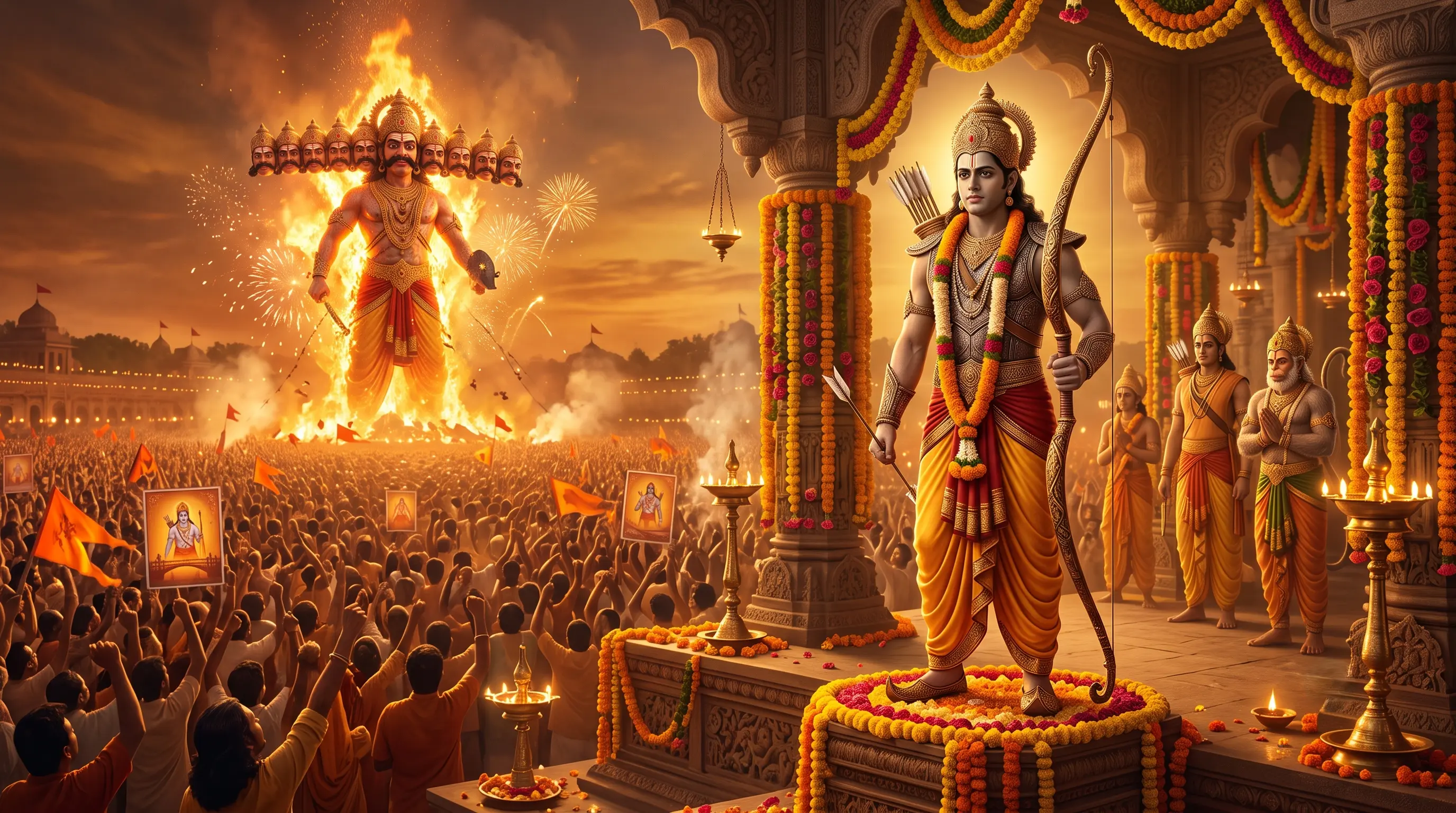
Dussehra 2026
By DivineAdda Editorial Team · How we write · Last updated
Dussehra 2026, also known as Vijayadashami, falls on October 20. Discover its date, Vijay Muhurat, Dashami Tithi, Ramayana significance, Ravana Dahan, Shami Puja and regional traditions.
- Date
- 20 Oct 2026
- Tithi
- Dashami
- Region
- Pan-India
Already celebrated
Quick facts
- Festival
- Dussehra / Vijayadashami
- Date
- October 20, 2026
- Day
- Tuesday
- Tithi
- Dashami
- Deity / figures
- Lord Rama and Goddess Durga
- Main message
- Victory of dharma over adharma
- Main tradition
- Ravana Dahan
- Auspicious period
- Vijay Muhurat
- Regional observance
- Durga Visarjan, Ayudha Puja, Shami Puja
- Associated festival
- Sharad Navratri
Dussehra 2026: Vijayadashami Date, Muhurat, Puja, Significance & Traditions
Dussehra 2026, also known as Vijayadashami or Dasara, will be observed on Tuesday, October 20, 2026 in most parts of India. The festival marks the victory of righteousness over evil and is associated with two major Hindu traditions: Lord Rama's victory over Ravana and Goddess Durga's victory over Mahishasura.
Dussehra comes at the conclusion of the Sharad Navratri period and is one of the most significant festivals in the Hindu calendar.
When is Dussehra in 2026?
Dussehra, or Vijayadashami, falls on:
Tuesday, October 20, 2026
The Dashami Tithi begins at approximately 12:50 PM on October 20 and ends at approximately 2:11 PM on October 21, according to the referenced Indian Panchang calculations.
Because Hindu festival timings depend on sunrise, location and local Panchang calculations, the exact Puja and Vijay Muhurat should be checked for your city.
Dussehra Vijay Muhurat 2026
Vijay Muhurat is the auspicious period associated with Vijayadashami. It falls during the Aparahna period and is traditionally considered suitable for auspicious activities and certain Dussehra rituals.
The exact Vijay Muhurat varies by location. For example, the 2026 calculation for Phaltan, Maharashtra gives approximately 2:14 PM to 3:00 PM. Other Indian locations have slightly different timings.
Always check your local Panchang before performing time-sensitive rituals.
Why is Dussehra celebrated?
Dussehra represents the triumph of dharma over adharma and good over evil.
In the Ramayana tradition, Vijayadashami commemorates Lord Rama's victory over the demon king Ravana after the battle of Lanka.
In Shakta traditions, Vijayadashami also follows the victory of Goddess Durga over Mahishasura and marks the conclusion of the Durga Puja period.
Therefore, Dussehra carries both Vaishnava and Shakta significance across different regions of India.
The Story of Lord Rama and Ravana
According to the Ramayana tradition, Ravana abducted Sita and took her to Lanka. Lord Rama, with the support of Lakshmana, Hanuman and the Vanara forces, eventually fought Ravana's army.
After the great battle, Lord Rama defeated Ravana.
Dussehra commemorates this victory and reminds devotees that arrogance, injustice and misuse of power ultimately cannot prevail over righteousness.
The burning of Ravana's effigy in many parts of India symbolizes the destruction of evil qualities and the victory of dharma.
Ravana Dahan
One of the most recognizable Dussehra traditions is Ravana Dahan, in which large effigies representing Ravana are ceremonially burned.
Effigies of Ravana are often accompanied by representations of Kumbhakarna and Meghanada.
The ceremony is generally held in the evening after the day's religious observances, although exact timings vary by city and local tradition.
The symbolic message is not simply the destruction of a character from the Ramayana. It represents the need to overcome qualities such as:
Ego
Anger
Greed
Arrogance
Hatred
Deceit
Injustice
Dussehra and Goddess Durga
In many eastern parts of India, Vijayadashami is closely connected with Durga Puja.
After several days of worshipping Goddess Durga, Vijayadashami marks the ceremonial conclusion of the festival and is associated with Durga Visarjan.
The mythology of Goddess Durga's victory over Mahishasura represents the triumph of divine Shakti over destructive forces.
This makes Vijayadashami an important festival in both the Ramayana and Durga Puja traditions.
Dussehra and Sharad Navratri
Dussehra is the culmination of the Sharad Navratri festival cycle.
The nine nights are dedicated to the worship of the Navadurga, while the tenth day is celebrated as Vijayadashami.
The sequence is:
Sharad Navratri → Durga Ashtami → Maha Navami → Vijayadashami
For DivineAdda readers, the Sharad Navratri 2026 page can provide the complete nine-day calendar, while this page focuses specifically on Vijayadashami.
Dussehra Puja
Dussehra Puja traditions vary considerably across India.
Depending on region and family tradition, devotees may perform:
Lord Rama Puja
Goddess Durga Puja
Shami Puja
Aparajita Puja
Ayudha Puja
Saraswati Puja
Vehicle Puja
Business and account-book Puja
Durga Visarjan
Ramlila and Ravana Dahan
The appropriate ritual should follow the devotee's family and regional tradition.
Shami Puja on Dussehra
Shami Puja is an important Vijayadashami tradition in several regions.
The Shami tree has a special association with the Mahabharata and is traditionally considered auspicious.
On Dussehra, devotees may worship the Shami tree or its leaves and seek blessings for victory, prosperity and protection.
The custom and exact procedure vary by region.
Aparajita Puja
Aparajita Puja is another traditional Vijayadashami observance.
Aparajita means "the unconquered one." Worshipping Goddess Aparajita on Vijayadashami is traditionally associated with victory and protection.
Shami Puja, Aparajita Puja and Seema Avalanghan are traditionally performed during the Aparahna period.
Seema Avalanghan
Seema Avalanghan, also called Seemollanghan, is a traditional practice associated with Vijayadashami in some communities.
The term refers to crossing one's customary boundary and is connected with the historical tradition of beginning or commemorating victorious campaigns.
Today, it is primarily observed as a cultural and religious tradition in certain regions.
Ayudha Puja and Dussehra
In several parts of South India, the period surrounding Vijayadashami is associated with Ayudha Puja, the worship of tools, instruments, vehicles and implements used in one's work.
Students may worship books and learning materials, while workers, artisans and businesses may respectfully worship their tools and equipment.
The underlying idea is gratitude toward the means through which knowledge, skill and livelihood are pursued.
Dussehra in Different Parts of India
Dussehra is celebrated in diverse ways throughout India.
North India
Ramlila performances and Ravana Dahan are major attractions. Large public celebrations often dramatize episodes from the Ramayana.
Maharashtra
Vijayadashami is associated with traditions such as Shami Puja, exchanging Shami leaves symbolically as "gold" and beginning auspicious activities.
Karnataka
Mysuru Dasara is one of the best-known regional celebrations, featuring elaborate cultural and ceremonial events.
Himachal Pradesh
Kullu Dussehra has a distinctive tradition and continues beyond the day commonly observed as Vijayadashami elsewhere.
West Bengal
Vijayadashami concludes Durga Puja, with devotees participating in Sindoor Khela, farewell rituals and Durga Visarjan according to local tradition.
South India
Vijayadashami is associated in various communities with Ayudha Puja, Saraswati Puja, learning and auspicious beginnings.
Dussehra and New Beginnings
Vijayadashami is traditionally considered an auspicious occasion for beginning new activities.
Families may choose the day to:
Begin education
Start a new business activity
Purchase tools or equipment
Begin a new project
Perform vehicle Puja
Worship books and instruments
Seek blessings before an important undertaking
Regional traditions differ, so auspicious timing should be checked according to the local Panchang.
What should you do on Dussehra?
A simple Dussehra observance can include:
Clean the Puja area and home.
Take a bath and wear clean clothes.
Worship Lord Rama, Goddess Durga or the family deity.
Offer flowers, fruits and traditional Naivedya.
Recite suitable prayers or mantras.
Perform Shami or Aparajita Puja if part of your tradition.
Perform Ayudha or vehicle Puja where appropriate.
Attend Ramlila or Ravana Dahan respectfully.
Reflect on overcoming negative qualities within oneself.
Seek blessings for a righteous and prosperous year ahead.
Dussehra Mantra
Devotees may recite prayers according to their chosen tradition.
A simple mantra dedicated to Lord Rama is:
ॐ श्री रामाय नमः
Om Shri Ramaya Namah
Devotees may also recite the Rama Raksha Stotram, Ramcharitmanas, Durga Chalisa, Durga Saptashati or other devotional texts according to their tradition.
Dussehra and the Meaning of Victory
The deeper message of Vijayadashami goes beyond the external celebration.
Ravana is traditionally portrayed as highly knowledgeable yet overcome by ego and desire. The story therefore reminds devotees that knowledge without ethical discipline can also become destructive.
Dussehra invites us to examine our own inner obstacles:
Ego → humility
Anger → patience
Greed → generosity
Hatred → compassion
Fear → courage
Adharma → dharma
The festival becomes meaningful when its symbolism is reflected in everyday life.
Dussehra 2026 at a Glance
Festival: Dussehra / Vijayadashami
Date: Tuesday, October 20, 2026
Tithi: Dashami
Main significance: Victory of dharma over adharma
Ramayana tradition: Lord Rama's victory over Ravana
Shakta tradition: Goddess Durga's victory over Mahishasura
Main rituals: Rama Puja, Shami Puja, Aparajita Puja, Ayudha Puja and Ravana Dahan
Vijay Muhurat: Location-specific
Associated festival: Sharad Navratri
Bengal tradition: Vijayadashami / Durga Visarjan according to the regional calendar
The 2026 Indian Panchang calculations place the principal Vijayadashami observance on October 20, while the exact Muhurat varies by location.
May the spirit of Vijayadashami inspire us to choose truth, courage, humility and righteousness.
Jai Shri Ram!
Timeline
October 11, 2026
Sharad Navratri begins
Ghatasthapana and Navadurga worship begin.
October 18, 2026
Durga Ashtami
Major Navratri worship and regional Ashtami observances.
October 19, 2026
Maha Navami
Navami Puja and Homa according to tradition.
October 20, 2026
Vijayadashami
Dussehra, Shami Puja, Aparajita Puja and other regional observances.
October 20, 2026
Ravana Dahan
Public Ramlila and Ravana Dahan are held in many regions, generally in the evening.
October 20, 2026
Durga Puja conclusion
In many eastern traditions, Vijayadashami is associated with Durga Visarjan.
Frequently asked questions
When is Dussehra in 2026?
What is Vijayadashami?
What is the Vijay Muhurat for Dussehra 2026?
What is the significance of Dussehra?
When is Ravana Dahan in 2026?
Why is Ravana's effigy burned on Dussehra?
What is Shami Puja on Dussehra?
Is Dussehra connected to Durga Puja?
What is Ayudha Puja?
What mantra can be recited on Dussehra?
Sources & further reading
DivineAdda
Hindu Culture & Festival Research
Last updated 24 August 2026