
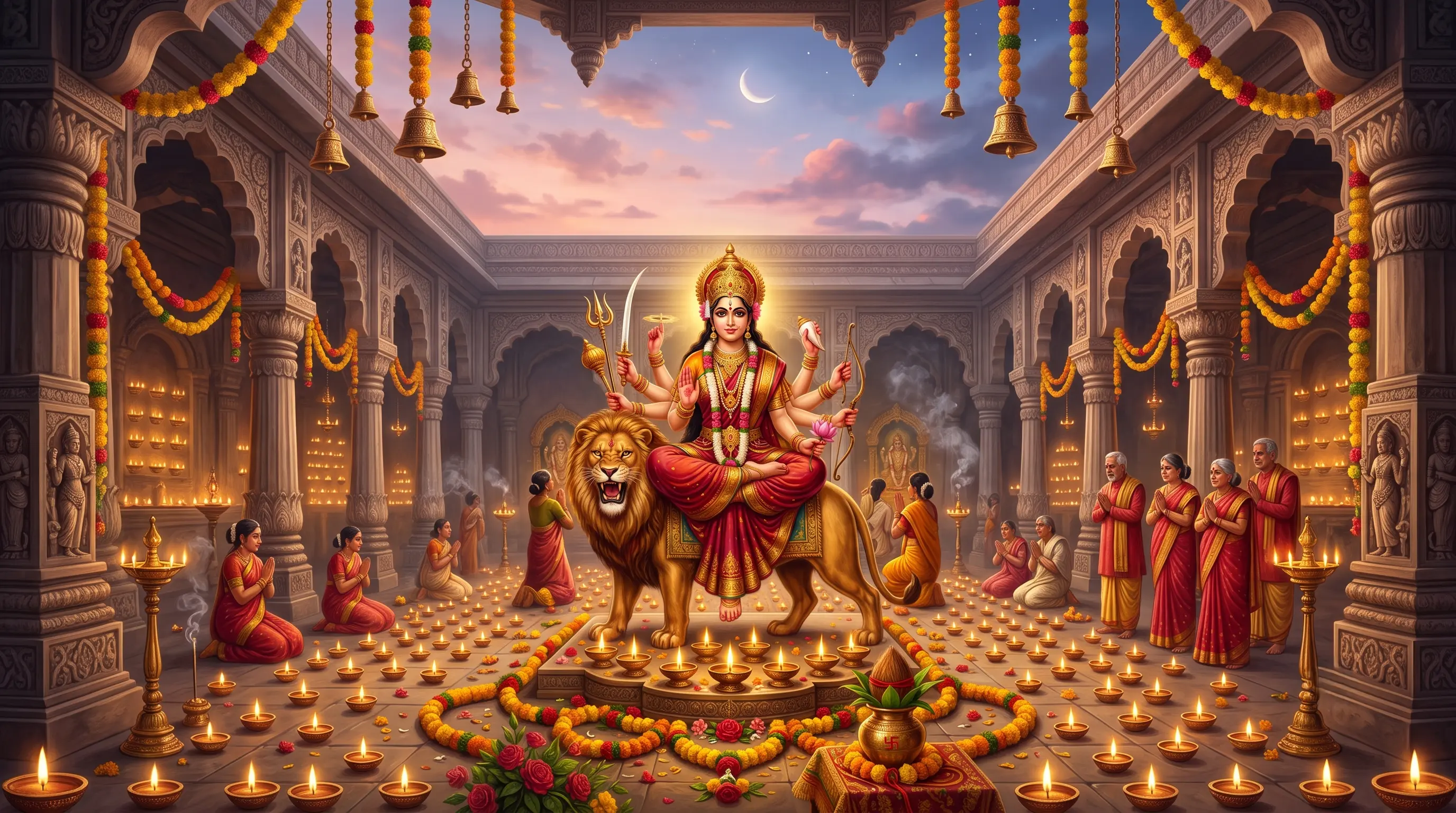
Sharad Navratri 2026
By DivineAdda Editorial Team · How we write · Last updated
Sharad Navratri 2026 begins on October 11. Explore Ghatasthapana Muhurat, Navratri dates, nine forms of Goddess Durga, daily Puja, fasting, Navratri colors, Ashtami, Navami and Vijayadashami.
- Date
- 11 Oct 2026
- Tithi
- Shukla Paksha Pratipada
- Region
- Pan-India
Already celebrated
Quick facts
- Festival
- Sharad Navratri 2026
- Also known as
- Shardiya Navratri
- Start date
- October 11, 2026
- Start day
- Sunday
- First Tithi
- Shukla Paksha Pratipada
- Deity
- Goddess Durga / Adi Shakti
- Forms
- Navadurga
- Ghatasthapana
- October 11, 2026
- Durga Ashtami
- October 18, 2026
- Maha Navami
- October 19, 2026
- Vijayadashami
- October 20, 2026
Sharad Navratri 2026: Dates, Ghatasthapana, Puja, Nine Forms of Durga & Navratri Calendar
Sharad Navratri 2026 begins on Sunday, October 11, 2026, and is one of the most important Hindu festivals dedicated to Goddess Durga and the divine feminine power, Shakti. The nine nights and ten days of worship culminate with Vijayadashami on Tuesday, October 20, 2026.
Sharad Navratri is also called Shardiya Navratri, Ashwin Navratri and Maha Navratri. It is observed during the lunar month of Ashwin and is dedicated to the worship of the nine forms of Goddess Durga, collectively known as Navadurga.
When is Sharad Navratri 2026?
Sharad Navratri begins with Ghatasthapana on Sunday, October 11, 2026.
The festival continues through nine days of Navadurga worship, fasting, prayers, devotional practices and regional celebrations. The tenth day is celebrated as Vijayadashami or Dussehra.
Ghatasthapana Muhurat 2026
Ghatasthapana, also known as Kalash Sthapana, marks the beginning of Navratri worship.
For Delhi in 2026, the Ghatasthapana Muhurat is approximately 6:19 AM to 10:12 AM on October 11, with an Abhijit Muhurat of approximately 11:44 AM to 12:31 PM. Muhurat calculations depend on local sunrise, location and Panchang factors, so devotees should check the Panchang for their city before performing the ritual.
Traditionally, Ghatasthapana is performed during the early part of the day while Pratipada Tithi is prevailing. It is generally avoided at night and during prohibited periods specified by the Panchang.
What is Ghatasthapana?
Ghatasthapana is the ritual installation of a sacred Kalash at the beginning of Navratri. It symbolizes the invocation of divine Shakti and establishes the sacred space for the nine-day worship.
A typical setup may include:
A Kalash
Clean water
Mango leaves
Coconut
Sacred thread
Rice or grains
Soil and barley seeds
Flowers
A lamp
Images or murtis of Goddess Durga
The exact procedure can vary according to family tradition, regional customs and sampradaya.
Sharad Navratri 2026 Calendar
Day 1 — October 11, 2026
Tithi: Pratipada
Goddess: Maa Shailputri
Main observance: Ghatasthapana
Maa Shailputri is worshipped on the first day of Navratri. She represents the divine feminine in her pure and foundational form.
Day 2 — October 12, 2026
Tithi: Dwitiya
Goddess: Maa Brahmacharini
Main observance: Brahmacharini Puja
Maa Brahmacharini represents devotion, discipline, austerity and spiritual determination.
Day 3 — October 13, 2026
Tithi: Tritiya
Goddess: Maa Chandraghanta
Main observance: Chandraghanta Puja
Maa Chandraghanta represents courage, protection and inner strength.
Day 4 — October 14, 2026
Tithi: Chaturthi
Goddess: Maa Kushmanda
Main observance: Kushmanda Puja
Maa Kushmanda is traditionally associated with creative energy, vitality and the sustaining power of the universe.
Day 5 — October 15, 2026
Tithi: Panchami
Goddess: Maa Skandamata
Main observance: Skandamata Puja
Skandamata is revered as the mother of Lord Skanda and represents maternal compassion and protective strength.
Day 6 — October 16, 2026
Tithi: Shashthi
Goddess: Maa Katyayani
Main observance: Katyayani Puja
Maa Katyayani represents courage and the powerful protective aspect of Goddess Shakti.
Day 7 — October 17, 2026
Tithi: Saptami
Goddess: Maa Kalaratri
Main observance: Kalaratri Puja
Maa Kalaratri represents the fierce protective aspect of Shakti and is traditionally associated with the destruction of fear and negativity.
Day 8 — October 18, 2026
Tithi: Saptami in the referenced regional calendar
Goddess: Maa Mahagauri
Main observance: Durga Ashtami
Durga Ashtami is an important day of Navratri worship. In many traditions, special prayers, offerings and Kanya Puja are performed around Ashtami or Navami according to local custom.
Day 9 — October 19, 2026
Tithi: Ashtami
Goddess: Maa Siddhidatri / Navadurga worship
Main observance: Maha Navami
Maha Navami marks the completion of the principal nine-day worship cycle in many traditions. Navami Homa and special prayers may be performed according to family or regional customs.
The precise tithi naming and observance can differ between regional Panchangs, so devotees should follow their local calendar for ritual timing.
Day 10 — October 20, 2026
Festival: Vijayadashami / Dussehra
Main observances: Ayudha Puja, Navratri Parana and Vijayadashami
Vijayadashami celebrates the triumph of dharma and good over evil and marks the conclusion of the Sharad Navratri period.
The Nine Forms of Goddess Durga
The nine forms worshipped during Navratri are known as Navadurga:
Maa Shailputri
Maa Brahmacharini
Maa Chandraghanta
Maa Kushmanda
Maa Skandamata
Maa Katyayani
Maa Kalaratri
Maa Mahagauri
Maa Siddhidatri
Each form represents a distinct aspect of Shakti and is associated with different qualities, symbols and devotional traditions.
Why is Sharad Navratri celebrated?
Sharad Navratri is celebrated as a period of devotion to Goddess Durga and the divine feminine power.
The festival is traditionally associated with the victory of divine forces over destructive forces and the triumph of dharma. Devotees use these nine nights for prayer, fasting, meditation, devotional singing and spiritual reflection.
The festival also has strong regional traditions. In Gujarat and Maharashtra, Navratri is celebrated with devotional Garba and Dandiya traditions, while in West Bengal the corresponding festive period is closely associated with Durga Puja.
Navratri Puja at Home
A simple home Navratri routine may include:
Clean the Puja area.
Perform Ghatasthapana according to the local Panchang.
Light a diya.
Invoke Goddess Durga through prayer.
Offer flowers and customary Naivedya.
Recite Durga mantras or devotional texts.
Perform Aarti.
Maintain the chosen fasting or dietary discipline.
Conclude each day's worship with prayers for the family.
The specific Puja Vidhi should follow the devotee's family tradition or the guidance of a knowledgeable priest.
Navratri Fasting
Many devotees observe a fast during Navratri. Fasting practices vary considerably.
Some devotees observe a complete fast, while others eat permitted foods such as fruits, milk, nuts, sabudana or traditional vrat preparations.
There is no single fasting practice followed by every Hindu community. DivineAdda recommends following one's family tradition and considering individual dietary requirements.
Read the full Navratri vrat rules and food list
Navratri Colors
Navratri colors are a popular regional tradition, particularly in parts of western India. The color assigned to each day can vary depending on the calendar system and region.
For this reason, devotees should use a location-specific Navratri calendar rather than assuming that one color sequence applies throughout India.
Ashtami and Navami
Durga Ashtami and Maha Navami are among the most significant days of Sharad Navratri.
Devotees may perform special Puja, Homa, Kanya Puja, Kumari Puja or other traditional observances according to their regional and family traditions.
In some traditions, young girls are worshipped symbolically as manifestations of the Divine Mother during Kanya Puja.
Vijayadashami and Dussehra
Sharad Navratri concludes with Vijayadashami, also known as Dussehra.
The day represents victory, righteousness and the restoration of dharma. Different regions observe Vijayadashami through different traditions, including Durga Visarjan, Ayudha Puja, Shami Puja and celebrations associated with Lord Rama's victory over Ravana.
Navratri Mantras
Devotees may recite traditional prayers dedicated to Goddess Durga during Navratri.
A commonly recited mantra is:
ॐ दुं दुर्गायै नमः
Om Dum Durgayai Namah
Devotees may also recite the Durga Saptashati, Devi Mahatmya, Durga Chalisa or other devotional texts according to their tradition.
Navratri and Garba
Garba and Dandiya are especially prominent during Navratri celebrations in Gujarat and other parts of India.
These devotional and cultural traditions bring communities together through music, dance and worship of the Divine Mother.
The form of celebration varies from region to region, making Navratri one of India's most diverse and culturally rich festivals.
Sharad Navratri 2026 at a Glance
Festival: Sharad Navratri
Also known as: Shardiya Navratri, Ashwin Navratri, Maha Navratri
Begins: Sunday, October 11, 2026
Ghatasthapana: October 11, 2026
Navratri worship: Nine nights and ten days
Primary deity: Goddess Durga / Adi Shakti
Forms worshipped: Navadurga
Durga Ashtami: October 18, 2026 in the referenced calendar
Maha Navami: October 19, 2026
Vijayadashami: Tuesday, October 20, 2026
Main rituals: Ghatasthapana, Durga Puja, fasting, Aarti, Kanya Puja and Navami Homa
Dates and ritual timings should be checked against the Panchang for the devotee's location because Hindu calendar calculations and Muhurats can vary by city.
May Maa Durga bless every home with strength, wisdom, peace and prosperity.
Jai Mata Di!
Timeline
October 11, 2026
Ghatasthapana
Navratri begins with Kalash Sthapana and Maa Shailputri Puja.
October 12, 2026
Day 2
Maa Brahmacharini Puja.
October 13, 2026
Day 3
Maa Chandraghanta Puja.
October 14, 2026
Day 4
Maa Kushmanda Puja.
October 15, 2026
Day 5
Maa Skandamata Puja.
October 16, 2026
Day 6
Maa Katyayani Puja.
October 17, 2026
Day 7
Maa Kalaratri Puja.
October 18, 2026
Durga Ashtami
Mahagauri Puja and Ashtami observances.
October 19, 2026
Maha Navami
Navami Puja and Homa according to tradition.
October 20, 2026
Vijayadashami
Navratri concludes with Vijayadashami / Dussehra.
Frequently asked questions
When does Sharad Navratri start in 2026?
When is Ghatasthapana in 2026?
How many days is Sharad Navratri?
Which Goddess is worshipped on the first day of Navratri?
What are the nine forms of Goddess Durga during Navratri?
When is Durga Ashtami in 2026?
When is Maha Navami in 2026?
When is Dussehra in 2026?
What is Ghatasthapana during Navratri?
Can Navratri fasting practices differ between families?
Sources & further reading
DivineAdda
Hindu Culture & Festival Research
Last updated 10 October 2026