Kalaratri and Raktabija: The Fiercest Form of Durga (Navratri Day 7)
By DivineAdda Editorial Team · How we write · Published
A demon whose every drop of blood created another demon, and the dark, fierce goddess who ended the battle. The story of Kalaratri, the seventh form of Durga, worshipped on 17 October 2026.
Quick facts
- Navratri day
- Day 7 (Saptami), 17 October 2026
- Form
- Kalaratri (Shubhankari)
- Mount
- Donkey
- Arms
- Four (abhaya, varada, sword, iron weapon)
- Chakra
- Sahasrara (crown)
- Key story
- Raktabija, Devi Mahatmya
The fiercest form of the Goddess
On the seventh night of Navratri, which falls on 17 October in 2026, devotees worship Kalaratri, the seventh form of Durga. After Katyayani, the warrior of the previous day, Kalaratri is the Goddess in her most fearsome appearance. Yet tradition also gives her a gentle name, Shubhankari, "the one who brings good."
What her name means
The name Kalaratri combines kala (time, death, or darkness) and ratri (night). It is often explained as "the night that ends darkness," or the night of time itself. She is shown as dark as the night sky, and her story is about facing what people fear most.
The demon who multiplied
Kalaratri's best-known story comes from the Devi Mahatmya, where the Goddess fights the demon brothers Shumbha and Nishumbha and their army. One of their commanders was Raktabija, a demon with a terrifying boon: every drop of his blood that fell on the ground would give rise to another demon as strong as he was.
A battle that could not be won
When the Goddess and her forces attacked Raktabija, each wound they inflicted made things worse. Every drop of blood that fell created a new Raktabija. Soon, the battlefield was filled with hundreds, then thousands of identical demons. The gods watched with fear. The more the Goddess fought, the larger the army became.
The Goddess calls on Kali
This is the moment where the fierce form appears. In the Devi Mahatmya, the Goddess calls on Kali, also called Chamunda, the dark and fearsome form that had emerged from her own fury earlier in the battle. In Navratri tradition, this form is honored as Kalaratri.
The Goddess instructed her to spread wide and take in every drop of Raktabija's blood before it could touch the ground, and to devour the demons that were already born. Kali did exactly that. With no new copies being created, the army of Raktabijas faded. The Goddess then struck the real Raktabija, and with no blood left to spread, he fell.
What Kalaratri looks like
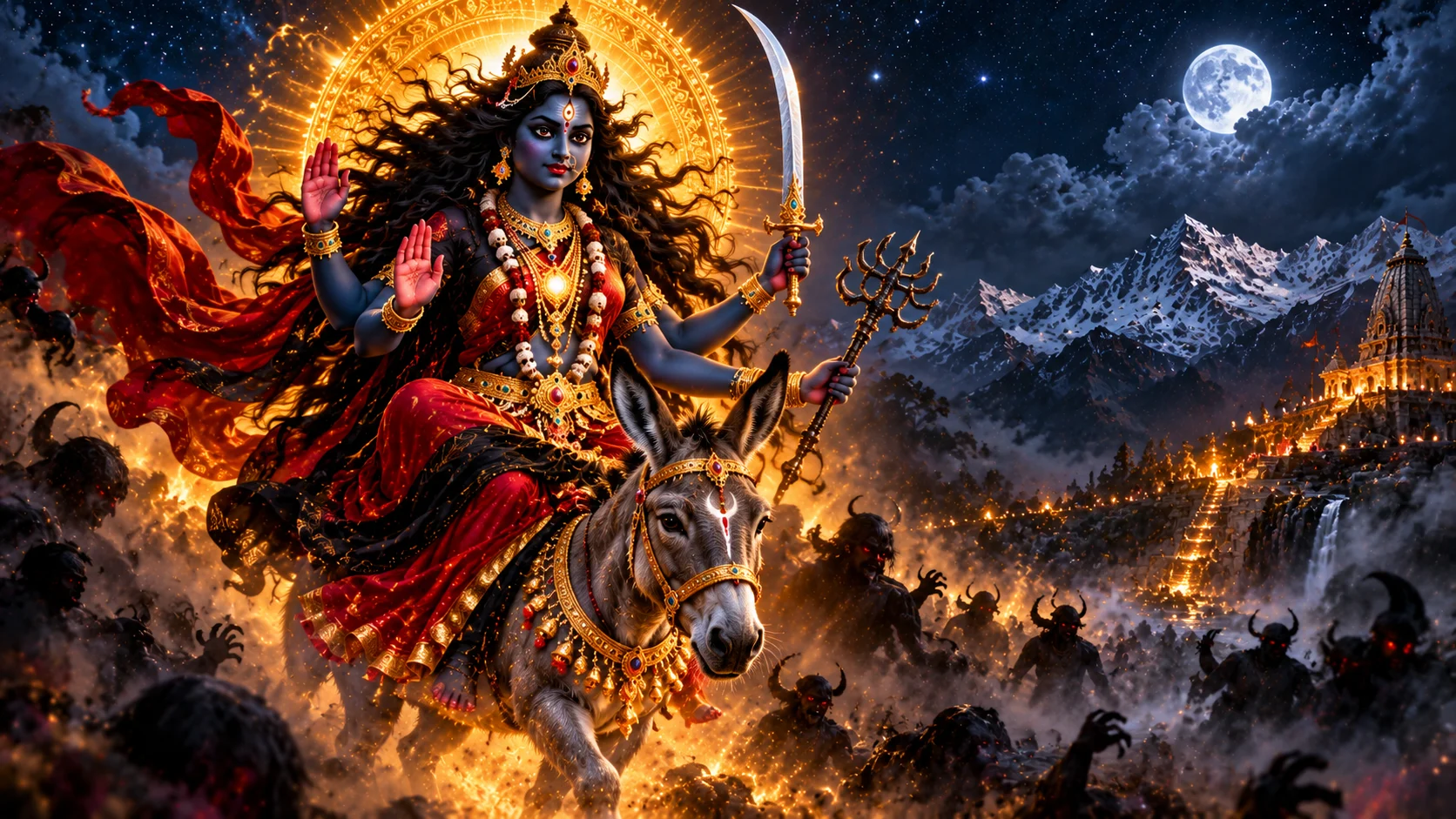
Kalaratri is shown with a dark complexion, wild, loose hair, and three eyes that shine like lightning. She wears a flashing necklace and is said to breathe flames. She rides a donkey. She has four arms: her right hands show the gestures of fearlessness (abhaya) and blessing (varada), and her left hands hold a sword and a fierce iron weapon. In yogic tradition, she is linked with the Sahasrara (crown) chakra.
Why she is called Shubhankari
Despite her terrifying appearance, Kalaratri is always described as protective. Devotees believe she drives away fear, negative energies and evil influences, and that she brings good results to those who worship her, which is where the name Shubhankari comes from. The raised hands of blessing and fearlessness in her form are a sign of this: the fiercest face of the Goddess is turned against evil, never against her devotees.
Kalaratri and Kali Puja
Kalaratri is closely connected with the worship of Kali. In Bengal and eastern India, Kali Puja is performed on the new moon night of Diwali, which in 2026 falls on 8 November. For the full story of that festival, see Why Diwali Marks Rama's Return to Ayodhya.
What the story teaches
Raktabija's story is often read as a lesson about problems that multiply when you fight them in the wrong way. Each strike only made more demons. What solved it was not more force, but a different method: cutting off the source. Kalaratri's form teaches that the thing people fear most, darkness itself, can be faced directly, and when faced, it loses its hold. In the Navadurga journey, she is the fierce, dark seventh night that comes right before the calm of Mahagauri. For all nine forms in order, see our Navadurga guide, and for dates and rituals, see Sharad Navratri 2026 and our 9 Days, Colours & Significance guide.
Next in the series: after the fiercest form comes the calmest, in Mahagauri and Kanya Puja: The Story of Durga Ashtami.
Note on sources: Kalaratri as the seventh form appears in the Devi Kavacha. The story of Raktabija is from the Devi Mahatmya (Markandeya Purana), where the fierce goddess is called Kali or Chamunda. Navratri tradition identifies her with Kalaratri, and the weapons and iconography vary between traditions.
Timeline
The war
Shumbha and Nishumbha's army
Raktabija is one of their commanders
The problem
Every drop of blood becomes a new demon
The battlefield fills with copies
The turning point
The Goddess calls on Kali (Chamunda)
The fierce form of the Goddess
The solution
Every drop is taken in before it touches the ground
No new copies can be born
The end
Raktabija falls
The war turns in the Goddess's favour
17 October 2026
Navratri Day 7
Kalaratri worshipped
Sources & further reading
- Devi Kavacha
- Devi Mahatmya (Markandeya Purana)
- Katyayani: Navratri Day 6
- Navadurga: Nine Forms of Durga (pillar)
DivineAdda Editorial
Scripture research and editorial team
Last updated 18 October 2026