Kushmanda: The Goddess Who Created the Universe with a Smile (Navratri Day 4)
By DivineAdda Editorial Team · How we write · Published
Before the sun, the stars or time itself, there was only darkness. Then a gentle smile created everything. The story of Kushmanda, the fourth form of Durga, worshipped on 14 October 2026.
Quick facts
- Navratri day
- Day 4 (Chaturthi), 14 October 2026
- Form
- Kushmanda (Ashtabhuja Devi)
- Mount
- Lion
- Arms
- Eight
- Chakra
- Anahata (heart)
- Residence
- Core of the Sun (Surya Mandal), per tradition
From the wedding to the beginning of everything
On the fourth night of Navratri, which falls on 14 October in 2026, devotees worship Kushmanda, the fourth form of Durga. The first three days followed a story: a rebirth (Shailaputri), a penance (Brahmacharini) and a wedding (Chandraghanta). Day 4 steps back from the story and asks a bigger question: where did the universe itself come from?
The meaning of her name
The name Kushmanda is made of three Sanskrit words: ku (a little), ushma (warmth or energy) and anda (egg). Together they mean "the one who created the cosmic egg with a little warmth." In Hindu thought, the universe is often described as a cosmic egg (Brahmanda), and Kushmanda is the goddess behind it. The word kushmanda is also the Sanskrit name for the pumpkin (ash gourd), and in tradition the goddess is said to be fond of pumpkin offerings.
Darkness, and then a smile
According to popular Navratri tradition, there was a time when nothing existed. No light, no space, no life, only vast darkness and silence. In that emptiness, the goddess smiled gently. That smile released a spark of energy, and from that spark the cosmic egg took shape. Light spread, and the universe began to unfold.
In many retellings, the three great gods and the divine feminine powers, Brahma, Vishnu, Shiva, and the goddesses Saraswati, Lakshmi and Parvati, emerge in this creation as well. Details vary between tellings, but the central idea stays the same: creation begins with a smile of the Goddess, not with force.
Why she is said to live inside the Sun
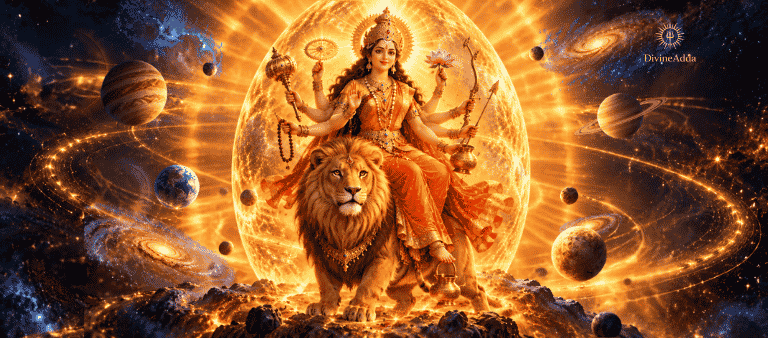
Tradition says Kushmanda lives in the Surya Mandal, the core of the Sun, and that her radiance is the source of the Sun's own light and energy. She is described as the only deity with the power to live there. For devotees, this is why she is associated with energy, health and vitality, and why her form is bright and warm.
What Kushmanda looks like
Kushmanda is shown with eight arms (which is why she is also called Ashtabhuja Devi). Her hands hold a kamandalu (water pot), a bow, an arrow, a lotus, a kalash of nectar (amrita), a chakra and a mace, while the eighth hand holds a japa mala that is believed to grant spiritual powers. She rides a lion. In yogic tradition, she is linked with the Anahata (heart) chakra, associated with love, compassion and emotional balance.
A related story: the same cosmic power in the Devi Mahatmya
The Devi Mahatmya opens with a story that shows the same idea, the Goddess as the power behind the cosmos, though it does not name her Kushmanda. At the end of a cosmic cycle, Vishnu lay asleep on the serpent Shesha in the cosmic ocean. From his ear came two demons, Madhu and Kaitabha, who threatened Brahma, who sat on a lotus rising from Vishnu's navel.
Brahma could not wake Vishnu, so he praised Yoga Nidra, the Goddess who is the power of cosmic sleep and illusion (Mahamaya), asking her to release Vishnu. When she withdrew, Vishnu awoke and fought the two demons for thousands of years. Enchanted by Mahamaya, the demons offered Vishnu a boon, and he asked that they be slain by him. They said he could do so only where the earth was not covered by water. Vishnu placed them on his thigh and ended them.
The story's message is that even Vishnu depends on the Goddess's power to wake and act. In the Devi Mahatmya's view, she is the energy behind every beginning, which is exactly the role Kushmanda holds on the fourth night.
What Kushmanda represents
Kushmanda is the goddess of beginnings and energy. Devotees pray to her for health, vitality and a fresh start, and she is traditionally invoked to dispel gloom. Her story suggests that creation starts gently, with warmth and a smile, and not with force. In the Navadurga journey, she follows Chandraghanta (courage) and comes before Skandamata (motherhood): once strength has been shown, the goddess is honored as the source of life itself. For all nine forms in order, see our Navadurga guide, and for dates and rituals, see Sharad Navratri 2026 and our 9 Days, Colours & Significance guide.
Note on sources: Kushmanda as the fourth form appears in the Devi Kavacha. The creation-by-smile account comes from popular Navratri tradition and varies between retellings. The Madhu-Kaitabha story is from the first chapter of the Devi Mahatmya, which speaks of Yoga Nidra, not Kushmanda by name.
Timeline
Before creation
Only darkness
No light, space or life existed
The smile
Kushmanda creates the cosmic egg
A gentle smile releases the first spark of energy
Creation
The universe unfolds
Light spreads, and in many retellings the Trimurti and Tridevi emerge
Devi Mahatmya
Madhu and Kaitabha
Yoga Nidra releases Vishnu, who defeats the two demons
14 October 2026
Navratri Day 4
Kushmanda worshipped
Sources & further reading
- Devi Kavacha
- Devi Mahatmya, Chapter 1
- Chandraghanta: Navratri Day 3
- Navadurga: Nine Forms of Durga (pillar)
DivineAdda Editorial
Scripture research and editorial team
Last updated 13 October 2026