Sati to Shailaputri: The Story of Goddess Durga's First Form (Navratri Day 1)
By DivineAdda Editorial Team · How we write · Published
Navratri begins with Shailaputri, the "daughter of the mountain." But she was Sati first. How a goddess who gave up her life at her father's yajna returned as Parvati, and why every Navratri starts with her.
Quick facts
- Navratri day
- Day 1 (Pratipada), 11 October 2026
- Form
- Shailaputri
- Mount
- Nandi, the bull
- Symbols
- Trident (right hand), lotus (left hand)
- Chakra
- Muladhara (root)
Why Navratri starts with Shailaputri
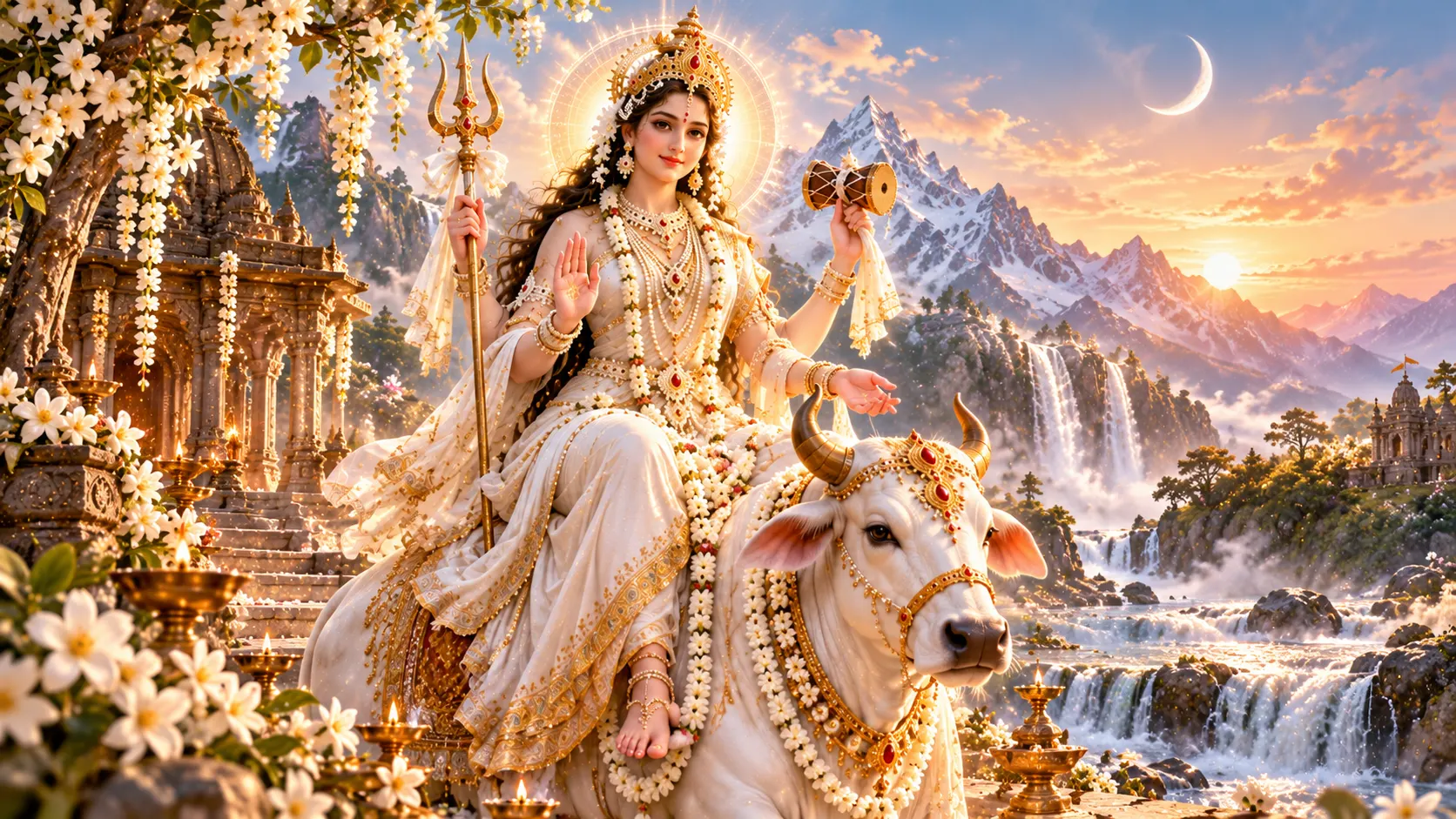
On the first night of Navratri, which falls on 11 October in 2026, devotees worship Shailaputri, the first of the nine forms of Durga. Her name means "daughter of the mountain" (shaila = mountain, putri = daughter). Her story, though, begins long before she was born to the mountains, with a goddess called Sati. To see why the festival opens with her, we have to start with Sati. For all nine forms together, see our Navadurga guide.
Sati, the daughter of Daksha
Sati was the daughter of Daksha Prajapati, one of the great progenitors in Hindu tradition. Against her father's wishes, she chose to marry Shiva, whom Daksha looked down on as an ascetic who lived in cremation grounds with ghosts and ash. Daksha never accepted the match, and the tension between father and son-in-law grew over the years.
The yajna that Shiva was not invited to
Daksha later organized a grand yajna and invited gods, sages and kings from across the worlds. He deliberately left out Shiva and Sati. When Sati learned of it, she wished to attend anyway, and the tradition says she went despite Shiva's advice that she should not go uninvited.
At the yajna, Daksha publicly insulted Shiva in front of the whole assembly. Unable to bear the humiliation of her husband, Sati gave up her life, entering the fire of her own yogic power.
Shiva's grief and the Shakti Peethas
When Shiva heard what had happened, his grief and fury were beyond measure. He created the fierce Virabhadra, who destroyed Daksha's yajna. Then, carrying Sati's body, Shiva wandered the world in sorrow, and the universe itself began to tremble.
According to tradition, Vishnu intervened by using his Sudarshan Chakra to separate Sati's body into pieces as Shiva carried her. The places where those pieces fell became the Shakti Peethas, sacred seats of the Goddess across the Indian subcontinent. Traditional lists count 51 of them, though the number differs between texts. This is why Shakti worship is so widespread, and why Navratri is celebrated at many of these sites.
Reborn as Parvati, daughter of the mountain
Sati did not stay lost. She was reborn as the daughter of Himavan, the king of the mountains, and his wife Mena. Because she was born to the Himalayas, she was called Parvati and, in her first Navratri form, Shailaputri. Even as a young girl, she was devoted to Shiva, and the story of how she won him is the next day's form, Brahmacharini.
How Shailaputri is depicted
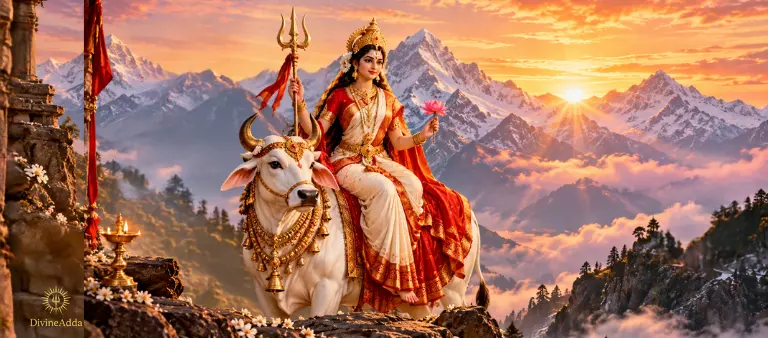
Shailaputri is shown riding Nandi, the bull, with a trident in her right hand and a lotus in her left. A crescent moon rests on her forehead. In yogic tradition, she is linked to the Muladhara (root) chakra, the base of spiritual energy, which fits her role as the first, foundational form.
Why she comes first
The nine forms of Navadurga trace one journey, and Shailaputri is where it begins. She represents a new birth after a great loss: the same soul, returning with clearer purpose. Traditionally, devotees begin Navratri by invoking her at Ghatasthapana, the opening ritual, asking for steadiness and a firm foundation for the nine nights ahead. You can find the day-wise schedule on our Sharad Navratri 2026 page, and rituals, colours and fasting guidance in Sharad Navratri 2026: 9 Days, Colours & Significance.
What the story teaches
Sati's story is not only about loss. It is about the idea that devotion and dignity can return in a new form, stronger than before. For the full account of what the Goddess became next, read Durga and Mahishasura: The Battle That Began Navratri.
Timeline
Before Navratri
Sati marries Shiva
Against her father Daksha's wishes
Daksha's yajna
Sati gives up her life
After Daksha insults Shiva publicly
After the yajna
Shakti Peethas formed
Places where Sati's body parts are said to have fallen
Rebirth
Parvati is born
Daughter of Himavan, the mountain king
11 October 2026
Navratri Day 1
Shailaputri worshipped at Ghatasthapana
Sources & further reading
DivineAdda Editorial
Scripture research and editorial team
Last updated 10 October 2026