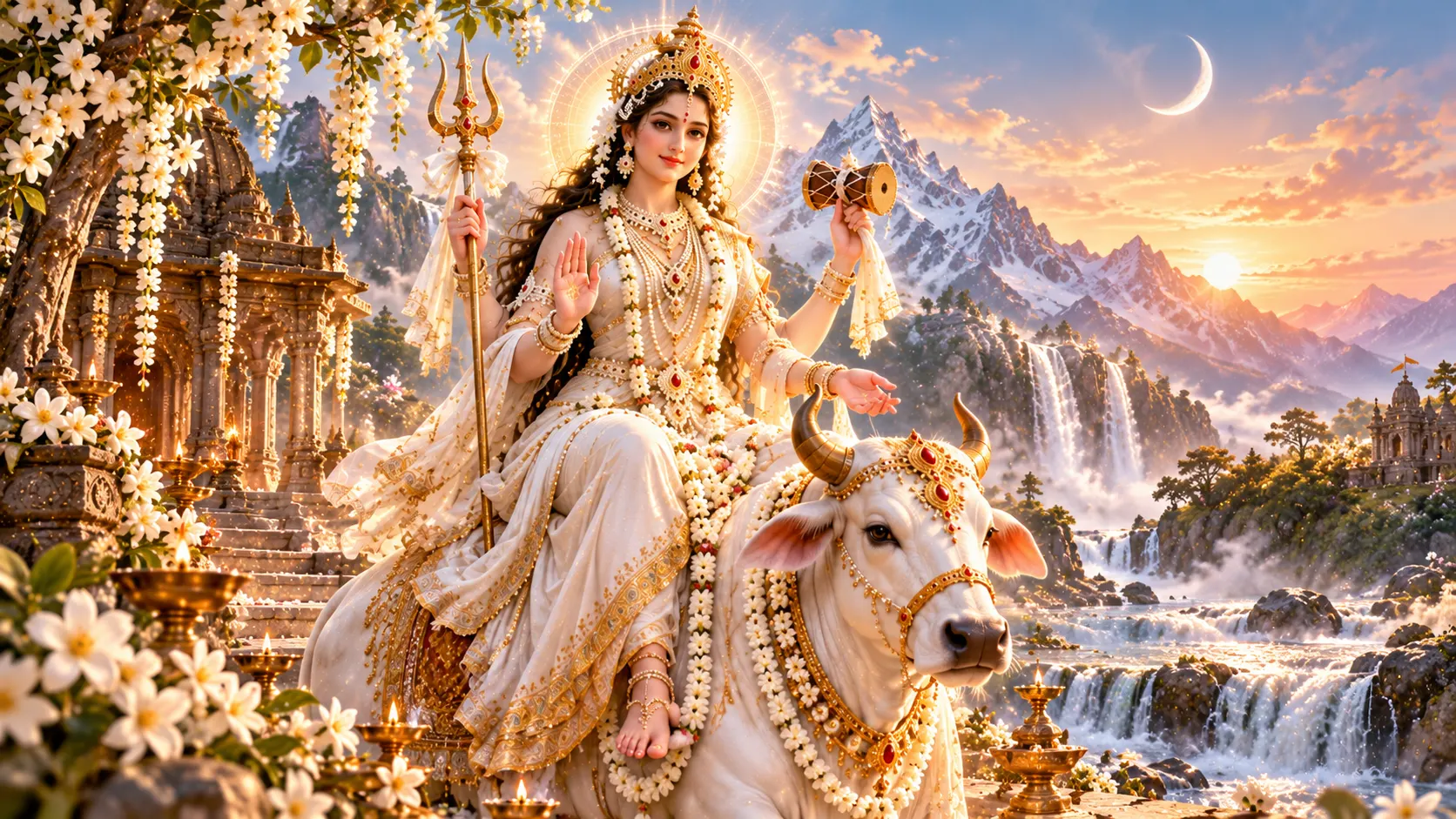

How Parvati Won Shiva: The Story of Brahmacharini (Navratri Day 2)
By DivineAdda Editorial Team · How we write · Published
Shiva was a hermit lost in meditation, and Parvati was a princess. She won him with years of penance, giving up even leaves. The story of Brahmacharini, the second form of Durga, worshipped on 12 October 2026.
Quick facts
- Navratri day
- Day 2 (Dwitiya), 12 October 2026
- Form
- Brahmacharini
- Symbols
- Rudraksha mala (right hand), kamandalu (left hand)
- Chakra
- Swadhisthana
- Also known as
- Aparna, Uma
From Shailaputri to Brahmacharini
On the second night of Navratri, which falls on 12 October in 2026, devotees worship Brahmacharini, the second form of Durga. She is Parvati at the moment she decided to win Shiva through her own effort. The story picks up where Sati to Shailaputri left off: the goddess has been reborn as the daughter of the mountain king Himavan, and she has not forgotten Shiva.
A prophecy from Narada
As Parvati grew up, the sage Narada visited her parents, Himavan and Mena. Reading her destiny, he told them she would marry Shiva. Her parents were worried. Shiva lived in cremation grounds, wore ash and matted hair, and had withdrawn from the world into deep meditation after losing Sati.
Parvati, however, was certain. Narada advised her that the only way to win a husband as detached as Shiva was through tapasya, penance of the highest order.
Why the gods wanted this marriage
There was a larger reason behind this story as well. The demon Tarakasura had received a boon that only a son of Shiva could defeat him. But Shiva was deep in meditation and showed no interest in marriage. The gods sent Kamadeva, the god of love, to stir Shiva's heart, and Shiva's third eye burned Kamadeva to ashes. This showed Parvati that attraction alone could not reach Shiva. It had to be earned through discipline and devotion.
Years of penance, one leaf at a time
Parvati left her palace and went into the forest to perform tapasya. The tradition describes her penance in stages. First she lived on fruits and flowers. Later, she ate only leaves. Then she took only the leaves of the bel tree, which is dear to Shiva. Finally she gave up even leaves.
Because she renounced even leaves, she came to be called Aparna, "the one without a leaf." Her mother Mena, worried by the severity of her penance, begged her to stop with the words "U Ma," meaning "O child, don't." This is one of the traditional explanations for the name Uma.
Through all of it, Parvati stayed barefoot, in simple clothes, holding a rudraksha mala in one hand and a kamandalu (water pot) in the other. This is exactly how Brahmacharini is depicted. The name comes from brahma (penance) and charini (one who practises).
Shiva tests her
When Shiva finally took notice, he decided to test her. He appeared before her disguised as a Brahmin and began criticizing Shiva, calling him an ascetic with no home, no wealth, and strange companions, and asking why such a princess would choose him.
Parvati was furious. She defended Shiva with complete conviction, and refused to listen to another word against him. Satisfied, Shiva revealed himself and accepted her. According to tradition, this is how the two came to be united, and it leads to the next day's form, Chandraghanta.
What Brahmacharini represents
In yogic tradition, Brahmacharini is linked with the Swadhisthana chakra. She represents the strength that comes from sustained discipline, not sudden power. Devotees pray to her for patience, steadiness and inner strength during difficult efforts. This is why she follows Shailaputri: after a firm foundation (Day 1), the next step is the work of discipline.
What the story teaches
Parvati's penance is often read as a lesson about perseverance. She did not give up when the road was long, when her parents doubted her, or when even the gods' plans failed. The story suggests that what you truly want is shaped by how steadily you pursue it. For all nine forms in order, see our Navadurga guide, and for the full schedule and rituals, see Sharad Navratri 2026 and our 9 Days, Colours & Significance guide.
Timeline
Childhood
Narada's prophecy
He tells Himavan and Mena that Parvati will marry Shiva
Penance begins
Parvati leaves for the forest
Fruits and flowers, then leaves, then only bel leaves
Peak of penance
Aparna
She gives up even leaves
The test
Shiva as a Brahmin
He criticizes Shiva, and Parvati defends him fiercely
12 October 2026
Navratri Day 2
Brahmacharini worshipped
Sources & further reading
- Shiva Purana, Rudra Samhita
- Sati to Shailaputri: Navratri Day 1
- Navadurga: Nine Forms of Durga (pillar)
DivineAdda Editorial
Scripture research and editorial team
Last updated 13 October 2026