
Siddhidatri and Maha Navami: The Goddess Who Grants Perfection (Navratri Day 9)
By DivineAdda Editorial Team · How we write · Published
The ninth night of Navratri ends with the goddess who grants siddhis, the eight perfections. The story of Siddhidatri, the half-and-half form of Shiva, and what Maha Navami means, on 19 October 2026.
Quick facts
- Navratri day
- Day 9 (Navami), 19 October 2026
- Form
- Siddhidatri
- Seat
- Lotus (a lion in some depictions)
- Arms
- Four (chakra, mace, conch, lotus)
- Key rituals
- Kanya Puja, havan, Ayudha Puja
- Next day
- Dussehra, 20 October 2026
The ninth night: where the journey ends
On the ninth night of Navratri, which falls on 19 October in 2026, devotees worship Siddhidatri, the ninth and final form of Durga. This day is called Maha Navami. The nine nights began with Shailaputri, the daughter of the mountain, and after the calm of Mahagauri, they now arrive at perfection itself.
What the name means
The name Siddhidatri combines siddhi (perfection, or a divine attainment) and datri (giver). She is "the giver of siddhis." In Hindu tradition, a siddhi is a spiritual power or accomplishment gained through discipline and devotion.
The eight siddhis
Tradition describes eight main siddhis, each giving a different kind of mastery:
- Anima: the power to become extremely small
- Mahima: the power to become extremely large
- Garima: the power to become very heavy
- Laghima: the power to become very light
- Prapti: the power to obtain whatever one wishes
- Prakamya: the power to have one's wishes fulfilled
- Ishitva: supreme lordship or authority
- Vashitva: mastery and self-control
Some texts describe more siddhis, and the lists vary between traditions.
Shiva's worship of the Goddess
According to the Devi Purana tradition, Lord Shiva himself worshipped the Great Goddess (Mahashakti), and it was through her grace that he received all the siddhis. This story shows that even the supreme yogi is understood to gain his powers through the Goddess, who is the source of all power.
The birth of Ardhanarishvara
The tradition continues that, out of compassion, the Goddess merged with half of Shiva's body. This is how Shiva became Ardhanarishvara, the form that is half male and half female. It represents the inseparable union of Shiva and Shakti. You can read more about this form in our guide to the avatars and forms of Lord Shiva.
What Siddhidatri looks like
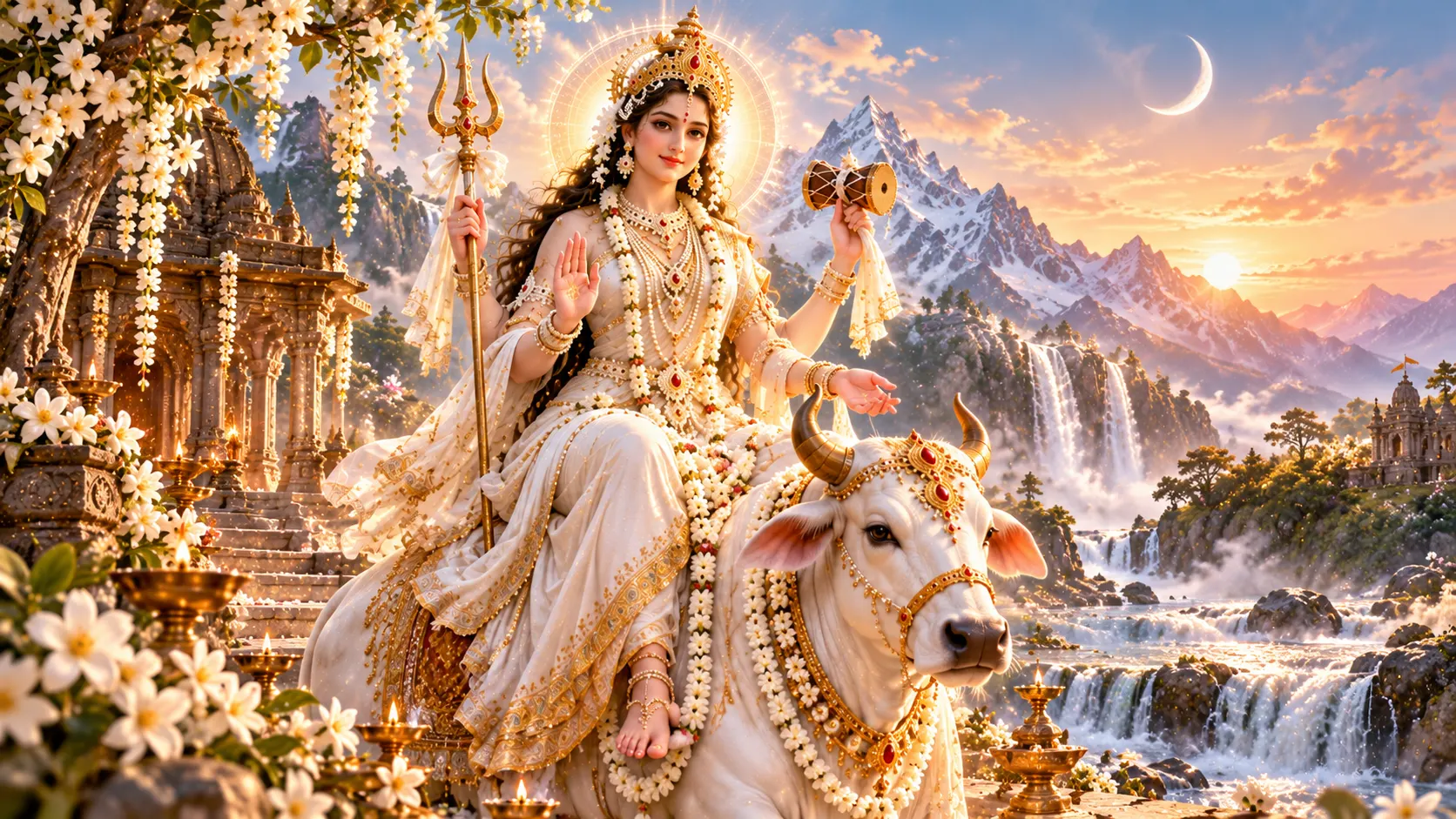
Siddhidatri is shown seated on a lotus, and in some depictions her mount is a lion. She has four arms holding a chakra (discus), a mace, a conch and a lotus. Her face is calm and gracious. Devotees pray to her for wisdom, success and spiritual fulfillment.
Maha Navami: how the nine nights conclude
Maha Navami is the day the festival reaches its close. The common traditions include:
- Kanya Puja, which can be done on Ashtami or Navami, whichever your family follows.
- Havan, a fire ritual in which offerings are made to complete the worship of the nine nights.
- Ayudha Puja and Saraswati Puja, especially in South India, when books, tools, instruments and vehicles are worshipped.
- Breaking the fast. Many families break the Navratri fast on Navami after the havan and Kanya Puja, while others do so on Dashami. Follow your family's tradition.
The nine forms in one line
It helps to look back at the whole journey: Shailaputri (birth and foundation), Brahmacharini (penance), Chandraghanta (courage), Kushmanda (creation), Skandamata (motherhood), Katyayani (the warrior), Kalaratri (the end of fear), Mahagauri (peace) and Siddhidatri (perfection). For all nine in order, see our Navadurga guide.
What the story teaches
Siddhidatri's place at the end tells us that perfection is not sudden. It follows a full sequence of birth, discipline, courage and calm. Spiritual teachers also remind devotees that siddhis are tools, not goals: the real fulfillment is humility and self-knowledge. For dates and rituals, see Sharad Navratri 2026 and our 9 Days, Colours & Significance guide. Tomorrow is Dussehra (Vijayadashami), the festival's day of victory. Read how Rama worshipped Durga before the war in Rama's Untimely Worship of Durga.
Note on sources: Siddhidatri as the ninth form appears in the Devi Kavacha. The account of Shiva receiving the siddhis through the Goddess and the birth of Ardhanarishvara is from the Devi Purana tradition. The eight siddhis are described in several texts, and the lists vary. Rituals differ by region and family, so follow your own tradition and confirm Navami timings with a local Panchang.
Timeline
Day 1
Shailaputri
The journey begins with the daughter of the mountain
Days 2 to 8
Penance, courage, creation, motherhood, battle, fearlessness and peace
Brahmacharini through Mahagauri
Devi Purana tradition
Shiva worships Mahashakti
He receives all siddhis through her grace
The union
Ardhanarishvara
Half of Shiva's body becomes the Goddess
19 October 2026
Navratri Day 9, Maha Navami
Siddhidatri worshipped
20 October 2026
Dussehra
Vijayadashami, the day of victory
Sources & further reading
- Devi Kavacha
- Devi Purana, Markandeya Purana
- Mahagauri: Navratri Day 8
- Avatars of Lord Shiva
- Navadurga: Nine Forms of Durga (pillar)
- Dussehra 2026
DivineAdda Editorial
Scripture research and editorial team
Last updated 20 October 2026