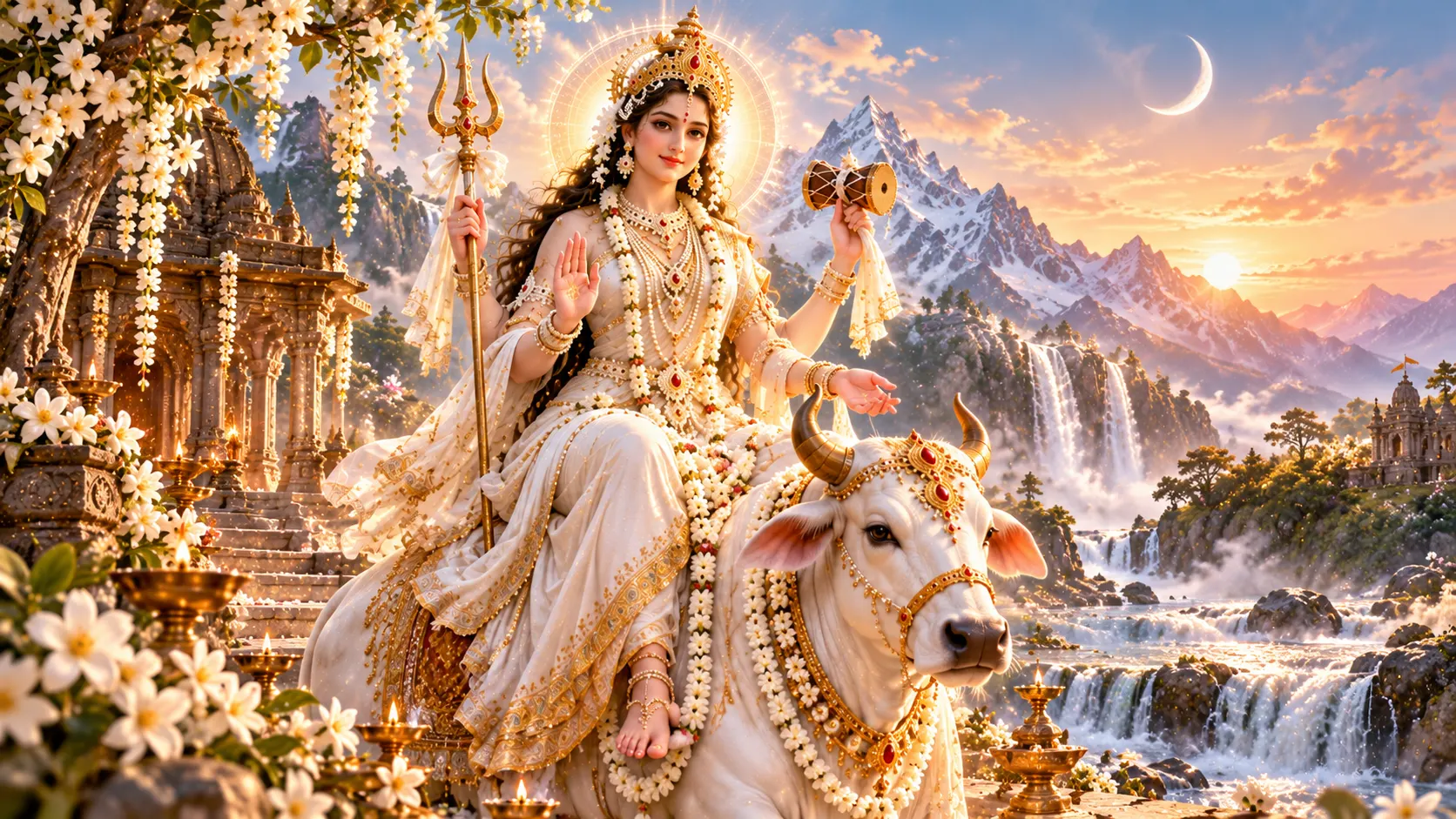

Katyayani: The Warrior Goddess Born for Sage Katyayana and Worshipped by the Gopis (Navratri Day 6)
By DivineAdda Editorial Team · How we write · Published
A sage's penance, the gods' combined fury, and a month-long vow by the gopis of Vrindavan. The story of Katyayani, the sixth form of Durga.
Quick facts
- Navratri day
- Day 6 (Shashthi), 16 October 2026
- Form
- Katyayani
- Mount
- Lion
- Arms
- Four (sword and lotus in the left hands)
- Chakra
- Ajna (third eye)
- Named after
- Sage Katyayana
From the mother to the warrior
On the sixth night of Navratri, which falls on 16 October in 2026, devotees worship Katyayani, the sixth form of Durga. The previous night showed the Goddess as a mother in Skandamata. Katyayani shows her as a warrior, the form most closely linked with the battle against the demon Mahishasura.
A sage who wished for the Goddess as his daughter
Katyayani gets her name from a sage called Katyayana. According to tradition, he performed long and intense penance with one wish: that the Supreme Goddess be born as his daughter. Pleased with his devotion, the Goddess promised to take birth in his home.
Why the Goddess was needed
The reason for her birth was a crisis. The demon Mahishasura had received a boon that made him nearly unbeatable by any god, and he had driven the gods out of heaven. The full account is in our story of Durga and Mahishasura.
When the gods could do nothing, the anger of Brahma, Vishnu and Shiva, together with the energy of the other gods, rose up as a blazing light. That light took the form of a radiant goddess. In the tradition that follows Sage Katyayana's story, she appeared in his ashram, and the sage was the first to worship her. Because she was honored as his daughter, she became known as Katyayani.
Three days of worship, then the battle
According to several Puranic accounts, Sage Katyayana worshipped the Goddess for three days, the seventh, eighth and ninth. On the tenth day, she defeated Mahishasura. This is the day celebrated as Vijayadashami, or Dussehra. That is why Katyayani is so closely tied to the victory at the end of Navratri.
What Katyayani looks like
Katyayani is shown with a radiant, golden complexion and four arms. In her right hands she makes the gestures of fearlessness and blessing. In her left hands she holds a sword and a lotus. She rides a lion. In yogic tradition, she is linked with the Ajna chakra, located between the eyebrows, associated with insight and willpower.
The gopis' Katyayani vrat
Katyayani is also at the center of a famous devotional story in the Bhagavata Purana. The young gopis of Vrindavan observed a month-long vow in the cold season. Each morning before dawn, they bathed in the river Yamuna, made an image of the Goddess from sand, and worshipped her as Katyayani. Their prayer was that Krishna, the son of Nanda, become their beloved. Devotional tradition reads this as a symbol of the soul's longing for the divine.
You can read more about Krishna's life in Vrindavan in our story of Krishna lifting Govardhan Hill.
The Katyayani mantra
The prayer the gopis are said to have recited is one of the best-known verses for Katyayani:
कात्यायनि महामाये महायोगिन्यधीश्वरि। नन्दगोपसुतं देवि पतिं मे कुरु ते नमः॥
Katyayani mahamaye mahayoginyadhishvari, Nandagopasutam devi patim me kuru te namah.
In simple terms, it addresses Katyayani as the great power of Maya and the supreme goddess of yogis, and asks for the blessing of union with Krishna, with a bow of respect.
Why she is invoked for marriage and courage
Because of the gopis' vrat, tradition holds that unmarried young women worship Katyayani for a suitable life partner and for harmony in marriage. She is also invoked by devotees who need courage to overcome obstacles, since she is the form that confronted Mahishasura.
What the story teaches
Katyayani's story shows two sides of devotion. One is the patient devotion of a sage who prayed for years, and of the gopis who kept a vow for a month. The other is the Goddess's strength when injustice grows too large to ignore. In the Navadurga journey, she follows Skandamata's nurturing strength with righteous action, and she leads directly into the final days of Navratri. For all nine forms in order, see our Navadurga guide, and for dates and rituals, see Sharad Navratri 2026 and our 9 Days, Colours & Significance guide.
Note on sources: Katyayani as the sixth form appears in the Devi Kavacha. The account of the Goddess born in Sage Katyayana's ashram comes from Puranic traditions such as the Skanda Purana, the Devi Bhagavata Purana and the Kalika Purana, with differences between them. The Devi Mahatmya tells the origin of the Goddess from the gods' combined energy but does not use the name Katyayani. The gopis' vrat is from the Bhagavata Purana, Book 10.
Timeline
Long ago
Sage Katyayana's penance
He prays for the Goddess to be born as his daughter
The crisis
Mahishasura drives out the gods
His boon makes him nearly unbeatable
The gods' fury
A blazing light takes form
The Goddess appears and is worshipped first by Sage Katyayana
Three days, then victory
She defeats Mahishasura
The day celebrated as Vijayadashami
In Vrindavan
The gopis' Katyayani vrat
A month-long vow, bathing in the Yamuna at dawn
16 October 2026
Navratri Day 6
Katyayani worshipped
Sources & further reading
- Devi Kavacha
- Skanda Purana, Devi Bhagavata Purana, Kalika Purana
- Bhagavata Purana, Book 10
- Skandamata: Navratri Day 5
- Durga and Mahishasura
- Navadurga: Nine Forms of Durga (pillar)
DivineAdda Editorial
Scripture research and editorial team
Last updated 17 October 2026