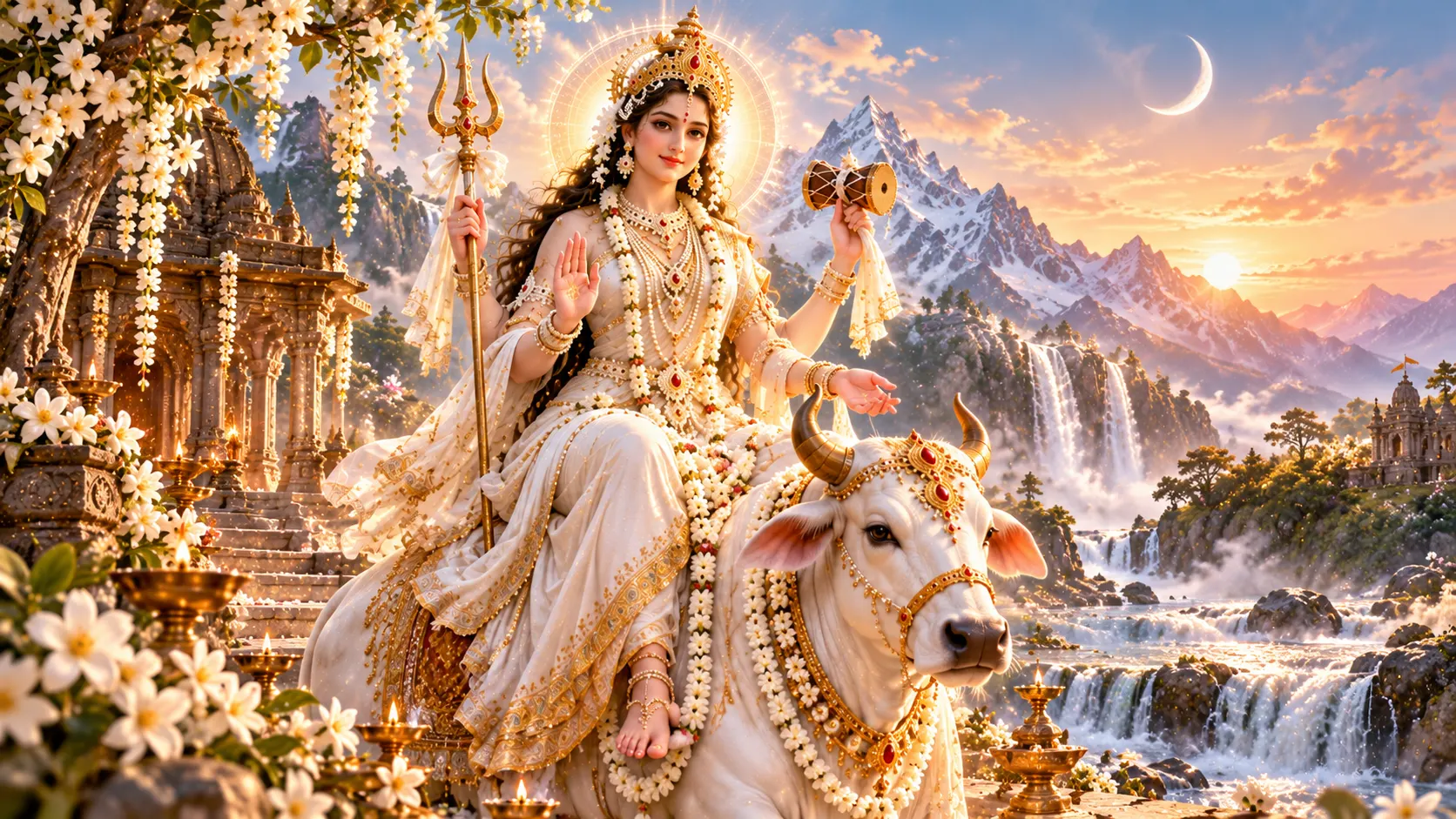

Skandamata: The Mother of Kartikeya and the Defeat of Tarakasura (Navratri Day 5)
By DivineAdda Editorial Team · How we write · Published
A demon could only be killed by Shiva's son, and Shiva had withdrawn from the world. The story of how Kartikeya was born, and of Skandamata, the fifth form of Durga, worshipped on 15 October 2026.
Quick facts
- Navratri day
- Day 5 (Panchami), 15 October 2026
- Form
- Skandamata (Padmasana Devi)
- Mount
- Lion
- Arms
- Four
- Child
- Skanda (Kartikeya, Murugan)
- Chakra
- Vishuddha (throat)
Why the gods needed a son of Shiva
On the fifth night of Navratri, which falls on 15 October in 2026, devotees worship Skandamata, the fifth form of Durga. Her name means "mother of Skanda," another name for Kartikeya, the war-god. To understand why this form matters, we need to go back to a demon named Tarakasura.
Tarakasura performed intense penance and received a boon from Brahma: he could be killed only by a son of Shiva. He believed this made him unbeatable, because Shiva had withdrawn into deep meditation after losing Sati and showed no sign of marrying again. Empowered by his boon, Tarakasura began to torment the gods and the three worlds.
How the story connects to Days 1 to 3
This is where the earlier days of Navratri fit in. The gods knew that Shiva needed a partner for a son to be born. This is why Parvati's penance as Brahmacharini mattered so much, and why the wedding, which gave us Chandraghanta, was such a turning point. The marriage of Shiva and Parvati was not only a love story. It was the first step toward ending Tarakasura's rule.
The birth of Skanda
The tradition describes the birth of Kartikeya in several versions, and the details vary between texts. In the widely told account, the divine energy that arose from the union of Shiva and Parvati was no ordinary thing. It was so intense that creation itself began to burn from its heat, and even Parvati could not hold it. In some tellings, the energy came out because the gods interrupted.
At the gods' request, Agni, the fire god, took it in first, but the fierce energy began to burn Agni himself, and he could not hold it for long. He handed it to the holy river Ganga, whose cool waters began to boil at its touch. Unable to keep it within her either, Ganga placed the divine energy in Sharavana, a thick forest of reeds on her bank. There, it took the form of a beautiful child with six faces.
Six celestial women, the Krittikas, who had come to the forest to fetch water, found the lone child and were filled with motherly love. With his six faces, he received the love and milk of all six, which is why he is called Kartikeya. Because of those six faces, he is also called Shanmukha. He is known as Skanda, Murugan and Subrahmanya in different traditions, and Parvati later accepted him as her own son.
Kartikeya defeats Tarakasura
When Kartikeya grew up, the gods appointed him the commander of their army, Devasenapati. Parvati gave him a divine spear, the Vel (also called Shakti), as a weapon. Leading the gods' forces, Kartikeya fought Tarakasura in a great battle and defeated him, fulfilling the condition of the boon, since the one who ended the demon was a son of Shiva.
Who is Skandamata?
Skandamata is the goddess in her role as the mother of Skanda. She is shown seated on a lotus, which is why she is also called Padmasana Devi, with the infant Skanda sitting in her lap. She has four arms: two hold lotuses, one holds the child, and one is raised in blessing. Her mount is a lion, and she is usually shown with a bright, fair complexion. In yogic tradition, she is linked with the Vishuddha (throat) chakra.
What Skandamata represents
Skandamata's story shows a different kind of strength. Earlier forms showed the goddess preparing for battle, such as Chandraghanta. Skandamata shows the strength of a mother: nurturing, protective, and shaping the one who will do what needs to be done. Tradition says devotees who worship her also receive the blessings of Kartikeya, because he is always with his mother. She is invoked for the wellbeing of children, for wisdom, and for a sense of peaceful strength.
In the Navadurga journey, she follows Kushmanda, the creator of the universe, with the next step in the story: once creation exists, it must be protected and nurtured. For all nine forms in order, see our Navadurga guide, and for dates and rituals, see Sharad Navratri 2026 and our 9 Days, Colours & Significance guide.
Note on sources: Skandamata as the fifth form appears in the Devi Kavacha. The account of Kartikeya's birth and the defeat of Tarakasura is told in the Shiva Purana, the Skanda Purana and in Kalidasa's Kumarasambhava, with differences in detail between them.
Timeline
Long ago
Tarakasura's boon
Brahma grants that only a son of Shiva can kill him
The gods' plan
Shiva and Parvati's union
Parvati's penance and the wedding make a son possible
The birth
Skanda is born in Sharavana
Nursed by the six Krittikas, hence Kartikeya
The war
Kartikeya leads the gods' army
Armed with the Vel given by Parvati
Victory
Tarakasura is defeated
The boon's condition is fulfilled
15 October 2026
Navratri Day 5
Skandamata worshipped
Sources & further reading
- Shiva Purana, Skanda Purana
- Kalidasa, Kumarasambhava
- Kushmanda: Navratri Day 4
- Navadurga: Nine Forms of Durga (pillar)
DivineAdda Editorial
Scripture research and editorial team
Last updated 15 October 2026