
Chandraghanta and Shiva's Wedding Procession: The Story of Navratri Day 3
By DivineAdda Editorial Team · How we write · Published
Shiva's wedding procession arrived with ghosts, snakes and ash, and Parvati's mother fainted at the sight. The popular story of how Parvati took the fierce form of Chandraghanta, worshipped on 13 October 2026
Quick facts
- Navratri day
- Day 3 (Tritiya), 13 October 2026
- Form
- Chandraghanta
- Mount
- Tiger
- Arms
- Ten, holding weapons
- Symbol
- Half-moon shaped like a bell on the forehead
- Chakra
- Manipura
From penance to the wedding day
On the third night of Navratri, which falls on 13 October in 2026, devotees worship Chandraghanta, the third form of Durga. The story continues from Brahmacharini, where Parvati wins Shiva through penance. Shiva has accepted her, the families have agreed, and the wedding day arrives. What happens next is one of the best-loved scenes in Shiva Purana retellings.
The most unusual wedding procession
When Shiva set out for Himavan's palace, he did not arrive as a typical bridegroom. His baraat (wedding procession) was made up of ganas, ghosts, goblins, ascetics and strange beings of every kind. Shiva rode Nandi, his body covered in ash, his hair matted, a tiger skin around him, with serpents as his ornaments. The gods and sages joined the procession too, but the wild company around Shiva made it unlike anything the mountain kingdom had ever seen.
Mena's shock
Parvati's mother Mena came out to welcome the groom. At the sight of the procession and of Shiva himself, she was overwhelmed with fear and worry. In the tradition, she fainted. She could not believe that her beautiful daughter, who had spent years in penance, was about to marry someone who looked so frightening.
The family was in turmoil. This is the moment the story turns to Parvati.
Parvati becomes Chandraghanta
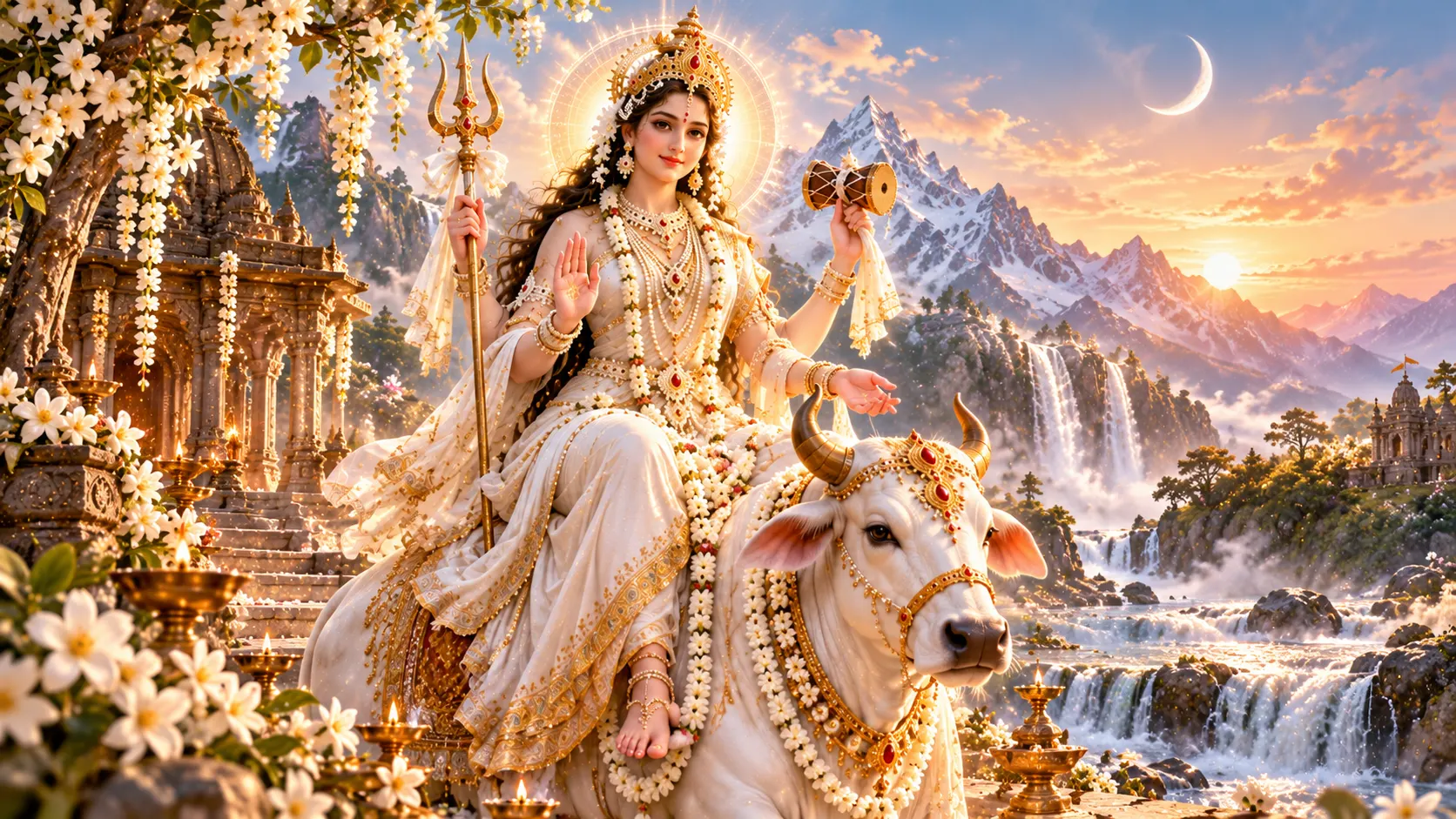
According to popular tradition, Parvati saw her family's distress and took a fierce, majestic form to restore calm. She appeared with a golden radiance and ten arms holding weapons, riding a tiger, with a half-moon shaped like a bell (ghanta) adorning her forehead. This is Chandraghanta, from chandra (moon) and ghanta (bell).
Her appearance showed everyone present that the bride was not helpless. She was a goddess with the strength to meet any difficulty, and she was entering this marriage by her own choice. Parvati then asked Shiva to take a form that would reassure her family. In the Shiva Purana's account, Shiva appeared as a radiant, handsome bridegroom, and the wedding went ahead. Mena's worry turned into joy.
Note on sources: the Navadurga list itself, including Chandraghanta as the third form, appears in the Devi Kavacha. The wedding-procession account comes from the Shiva Purana's story of Mena's reaction and Shiva's change of form, and the Chandraghanta detail is part of popular retellings. Versions differ in the details.
What Chandraghanta looks like
Chandraghanta is shown with a bright golden complexion and ten arms holding a trident, mace, sword, bow, arrow, lotus and other weapons, with one hand in a blessing gesture. She rides a tiger (some depictions show a lion). The bell-shaped crescent moon on her forehead is her defining feature. In yogic tradition, she is linked with the Manipura chakra, associated with courage and inner strength.
The bell and its meaning
Devotees believe the sound of Chandraghanta's bell drives away fear and negative energy. This is why bells and the ringing of the ghanta are so closely associated with her worship. She is said to grant bravery and calm in difficult moments, and her form is a reminder that grace and strength can exist together.
What the story teaches
Chandraghanta's story is about not being defined by appearances. Shiva looked frightening to Mena, but Parvati knew who he truly was. And Parvati's own gentleness did not mean weakness: she took a fierce form the moment it was needed. The third day of Navratri is traditionally read as the point where the goddess combines peace and courage. For all nine forms in order, see our Navadurga guide, and for dates and rituals, see Sharad Navratri 2026 and our 9 Days, Colours & Significance guide.
Timeline
After Brahmacharini
Shiva accepts Parvati
The two families agree to the marriage
Wedding day
The baraat arrives
Shiva comes with ganas, ghosts, snakes and ascetics
At the palace
Mena faints
Shocked by the sight of the procession
The turning point
Parvati becomes Chandraghanta
A fierce, golden, ten-armed form with a bell-shaped moon
Resolution
Shiva takes a radiant form
The wedding goes ahead
13 October 2026
Navratri Day 3
Chandraghanta worshipped
Sources & further reading
- Shiva Purana, Rudra Samhita
- How Parvati Won Shiva: Navratri Day 2
- Navadurga: Nine Forms of Durga (pillar)
DivineAdda Editorial
Scripture research and editorial team
Last updated 13 October 2026