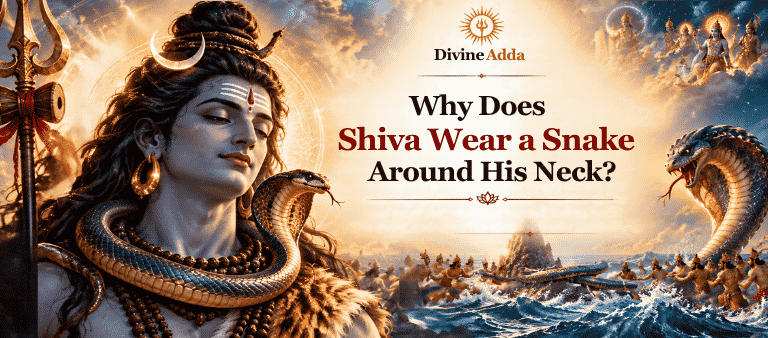
Why Does Shiva Wear a Snake Around His Neck?
By DivineAdda Editorial Team · How we write · Published · Last updated
Vasuki the serpent became a rope during the churning of the cosmic ocean — so how did he end up as the ornament around Shiva's neck? The story, and what the snake actually symbolizes.
Quick facts
- Deity
- Shiva
- Name of the serpent
- Vasuki, King of Serpents
- Connected event
- Samudra Manthan (Churning of the Cosmic Ocean)
- Symbolic meaning
- Victory over ego, fear and death
- Related festival
- Nag Panchami
The one detail that's always there
Across almost every depiction of Lord Shiva, a few things never change — the trident, the damaru, the third eye, and a serpent coiled around his neck. That serpent isn't decoration, and it isn't meant to be frightening. It comes from a specific story, and it carries several layers of meaning that go well beyond the image itself.
Vasuki and the churning of the cosmic ocean
The story begins with the well-known episode of Samudra Manthan — the churning of the cosmic ocean, undertaken jointly by gods and demons in search of Amrita, the nectar of immortality. To churn the ocean, they needed a massive rope wound around Mount Mandara, which served as the churning rod. Vasuki, king of the serpents, volunteered himself for this role, coiling his own body around the mountain to be used as the rope.
The churning was as punishing for Vasuki as it was powerful in effect. Being pulled back and forth repeatedly left him in tremendous pain, and when the churning finally brought forth Halahala, a poison deadly enough to destroy all creation, it emerged directly from Vasuki's own mouth, since he was the one bound around the churning rod.
Shiva drinks the poison, and accepts Vasuki
As Halahala threatened to annihilate everything, gods and demons alike turned to Shiva for protection. Shiva drank the poison to save creation — holding it in his throat rather than swallowing or releasing it, which turned his throat blue and earned him the name Neelkanth, "the blue-throated one."
Vasuki's contribution and suffering throughout this event were just as extraordinary. Tradition holds that Shiva, recognizing Vasuki's devotion and the immense pain he had endured, honored him by placing him around his own neck — not as a symbol of dominance or fear, but as a mark of companionship and respect for a devotee who had given everything in a moment of crisis.
More than one snake, more than one meaning
Beyond the specific story, the serpent around Shiva's neck carries several symbolic meanings layered on top of it:
Mastery over ego — a snake is traditionally associated with ego, desire, and fear. A serpent coiled calmly around Shiva's neck, alive but entirely under his control, represents complete mastery over these very tendencies.
Victory over death and fear — a snake's bite has long been associated with death. Shiva wearing one as an ornament suggests that for someone who has conquered the fear of death itself, even the most feared thing becomes something to be worn rather than avoided.
Time and rebirth — a snake periodically sheds its skin, which tradition reads as a symbol of the cycle of time, death, and renewal. For Shiva, the deity of both destruction and regeneration, this symbolism fits particularly well.
Kundalini energy — in yogic tradition, the dormant spiritual energy within a person is called Kundalini, often depicted as a coiled serpent. Shiva's serpent ornament is also read as a sign that he is the supreme yogi, one who has fully awakened and mastered this energy within himself.
Is it specifically Vasuki, or any snake?
Most Puranic depictions and stories identify the serpent around Shiva's neck specifically as Vasuki, largely because of this direct connection to the Samudra Manthan story. Some regional traditions and devotional hymns refer to Shiva more generally as wearing serpents as ornaments, reflecting his broader association with and protection of snakes rather than pointing to one specific incident.
The connection to Nag Panchami
This is part of why Nag Panchami is observed with particular devotion at Shiva temples — serpent deities are worshipped specifically that day, and offering milk or water to a Shiva Linga alongside a serpent image or figure is a common practice. Since snakes are considered dear to Shiva and worn as his own ornament, worshipping them is understood as an extension of worshipping Shiva himself.
What the story is really teaching
The snake around Shiva's neck carries a fairly direct lesson: the thing you fear the most can, through understanding, discipline, and courage, become something you wear rather than something you run from. Vasuki, who endured both pain and terror during the churning, ended up in the most honored position possible — draped around the neck of the very deity who saved creation. Service and devotion, however difficult, are ultimately met with recognition.
Timeline
Start of churning
Vasuki becomes the rope
Coiled around Mount Mandara to churn the cosmic ocean
During churning
Suffering
Vasuki endures immense pain from the constant pulling
End of churning
Halahala poison emerges
The deadly poison surfaces from Vasuki's mouth
Poison consumed
Shiva becomes Neelkanth
Shiva holds the poison in his throat to save creation
Honor given
Vasuki finds his place
Shiva places Vasuki around his own neck in recognition
Sources & further reading
DivineAdda Editorial
Scripture research and editorial team
Last updated 30 September 2026