Durga and Mahishasura: The Battle That Began Navratri
No god could defeat the shape-shifting demon Mahishasura — so the gods combined their powers to create a goddess who could. This is her story, and why it takes nine nights to tell.
Quick facts
- Deity
- Durga
- Demon
- Mahishasura
- Weapon highlights
- Trishul (Shiva), Chakra (Vishnu), Thunderbolt (Indra)
- Mount given by
- Himavan (the lion)
- Battle length
- 9 days and nights
- Ends on
- Vijayadashami / Dussehra
A demon no single god could kill
Mahishasura was no ordinary demon. Born of a union between a demon king and a buffalo, he could shift between human and buffalo form at will, which made him nearly impossible to pin down in battle. Through severe penance, he won a boon from Brahma: he could not be killed by any man or god. It's a boon built on a very specific loophole — one that assumes no one would think to look beyond "man" and "god" for a threat.
Confident in his invincibility, Mahishasura turned on the heavens. He drove Indra from his throne, humiliated the other gods, and took control of the three worlds. The gods — Brahma, Vishnu, Shiva, and the rest — found themselves powerless. Individually, every one of them was bound by the same boon that protected Mahishasura from them specifically.
An answer the boon didn't account for
Furious and desperate, the gods did something none of them could do alone: they combined their energies. From the combined light and fury of Brahma, Vishnu, Shiva, and the other gods emerged a being unlike anything Mahishasura's boon had anticipated — not a god, and not a man, but a goddess. This was Durga.
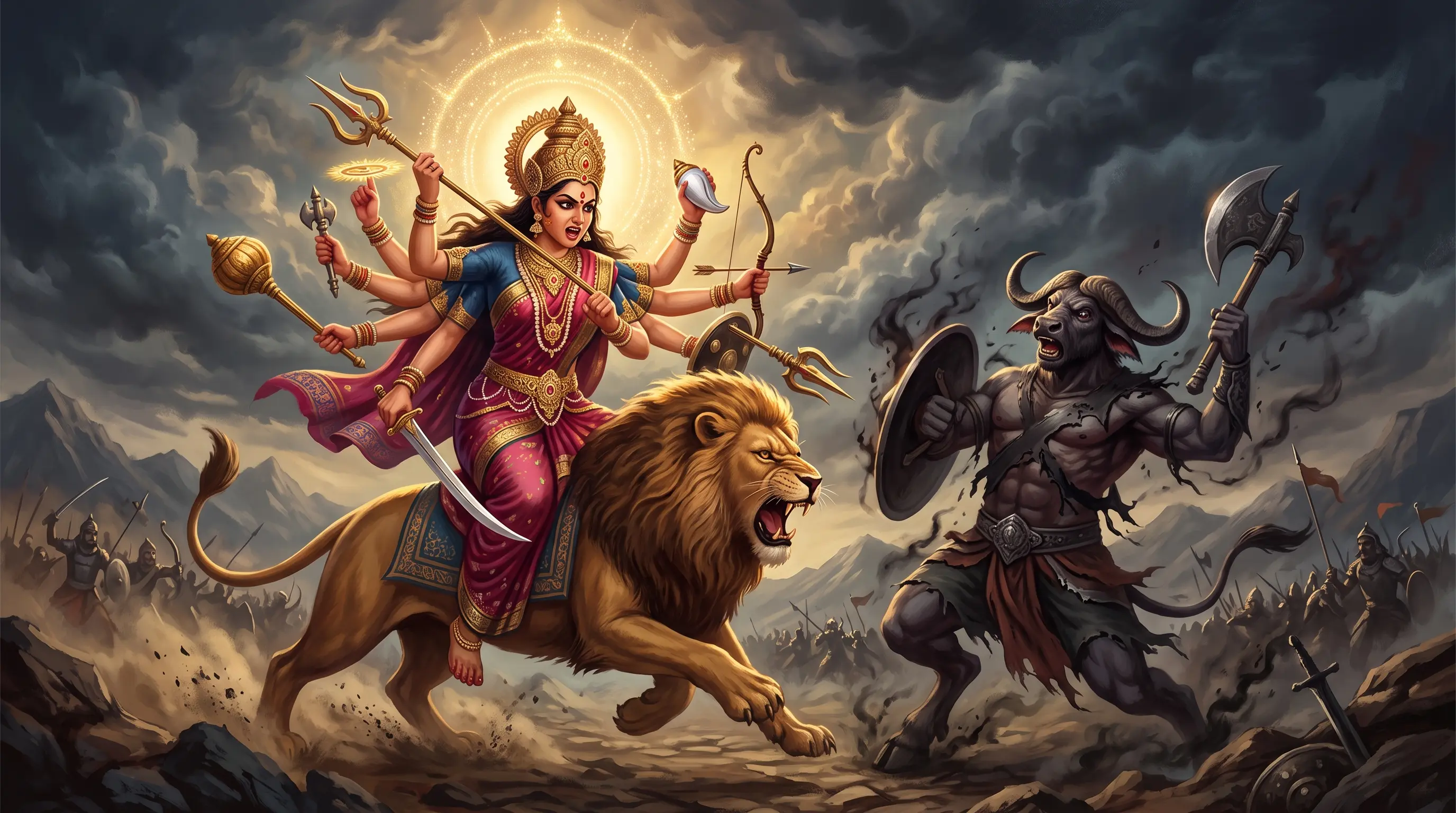
Each god contributed to her form. Shiva gave her his trishul. Vishnu gave his chakra. Indra gave his thunderbolt. Himavan, the mountain, gave her a lion to ride. Piece by piece, she was armed with the combined weapons of the entire pantheon — a being deliberately assembled to close the exact gap in Mahishasura's boon.
Nine nights of war
When Durga arrived to confront him, Mahishasura reportedly found her beauty almost amusing at first — he is said to have proposed marriage rather than taking her as a serious threat, underestimating her the same way he'd underestimated the possibility of a goddess altogether. The battle that followed lasted nine days and nights. Mahishasura shifted repeatedly between forms — buffalo, lion, elephant, human — trying to escape her onslaught in whatever body might give him an advantage.
On the tenth day, as he attempted to shift shape once more — caught halfway between buffalo and human — Durga struck him down. This moment, Mahishasura's defeat, is what Vijayadashami (Dussehra) commemorates: victory achieved on the tenth day, after nine nights of sustained battle.
Why nine nights, specifically
The length of the battle isn't incidental — it's the reason Navratri lasts nine nights at all. Each night of the festival is traditionally associated with a different form Durga took or drew upon in the course of confronting Mahishasura , building from quiet preparation through escalating intensity to final victory. The festival doesn't just commemorate the outcome; it re-enacts the sustained effort the outcome required.
Want the puja timings, fasting rules and colours for each of the nine days instead? See Sharad Navratri 2026: 9 Days, Colours & Significance.
A story about what individual power can't solve
Set aside the demon and the battle for a moment, and Mahishasura's story is really about the limits of individual strength. Brahma, Vishnu, and Shiva — each immensely powerful on their own — were each specifically unable to stop him. It took their combined effort, channeled into a form none of them could have created alone, to close a gap that no single power could close by itself. Durga isn't presented as more powerful than the gods who made her; she's presented as something they couldn't have been individually; unified, deliberate, and built specifically to answer the one threat that had outmaneuvered everyone else.
Sources & further reading
- Devi Mahatmya, Markandeya Purana
DivineAdda Team
Scripture research and editorial team
Last updated 18 September 2026