
Why Diwali Marks Rama's Return to Ayodhya
Fourteen years of exile, a war won, and a kingdom lit with a million lamps. The Ramayana story every Diwali diya is really about — and why it still shapes how the festival is celebrated today.
A homecoming, fourteen years in the making
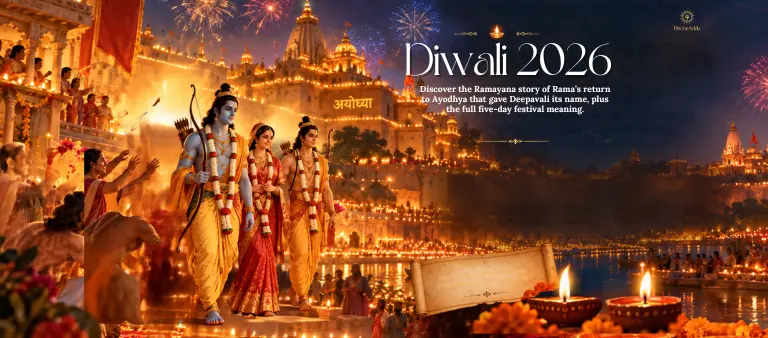
Long before Diwali became a festival of firecrackers, sweets, and Lakshmi Puja, it marked a single, specific event at the end of the Ramayana: Lord Rama, along with Sita and Lakshmana, returning to the kingdom of Ayodhya after fourteen years of exile — the last part of which involved a war fought to rescue Sita from the demon king Ravana.
Why they were in exile at all
Rama's exile began years earlier, when King Dasharatha of Ayodhya, bound by an old promise to his wife Kaikeyi, was forced to send his eldest son Rama into the forest for fourteen years rather than crown him king as planned. Rama accepted the exile without protest, and Sita and Lakshmana chose to accompany him rather than remain behind in comfort. What followed was over a decade in forest exile, culminating in Ravana's abduction of Sita and the war fought to recover her — the events covered in full in the story of Ravana.
The return, and a city lit to welcome it
When word reached Ayodhya that Rama, Sita, and Lakshmana were finally returning — their exile complete and the war won — the city's residents are said to have lit rows of earthen lamps throughout Ayodhya to welcome them home on a moonless night. The word Deepavali itself comes from this act: deepa (lamp) and avali (a row), literally "a row of lamps." The darkness of the new moon night, and the light laid out to meet it, is the specific image the entire festival is built around.
Why Lakshmi Puja happens the same evening
Diwali's other central ritual — the worship of Goddess Lakshmi — is closely tied to this same homecoming, though through a slightly different thread of tradition. Rama's return marked the restoration of rightful, righteous rule to Ayodhya after a long absence, and prosperity is understood in Hindu tradition to follow naturally from dharmic (righteous) governance. Lakshmi, goddess of wealth and abundance, is invited into homes on this night in that same spirit — not simply for personal wealth, but as an extension of the idea that light returning after darkness, and order returning after disruption, is what makes prosperity possible in the first place.
Five days, one continuous story
Diwali isn't a single day — it's a five-day sequence, and each day carries its own layer of meaning connected to this larger arc:
- Dhanteras (6 November 2026) opens the festival, honoring Dhanvantari, the physician-god who emerged from the churning of the cosmic ocean carrying both Amrita and the knowledge of Ayurveda.
- Choti Diwali / Naraka Chaturdashi (7 November) commemorates Krishna's defeat of the demon Narakasura, another "light over darkness" story that pairs naturally with the main event.
- Diwali / Lakshmi Puja (8 November) is the main day — Rama's return and Lakshmi's worship, marked by the main round of diyas, rangoli, and fireworks.
- Govardhan Puja (9–10 November, depending on region) recalls Krishna lifting Govardhan Hill to shelter villagers from Indra's wrath.
- Bhai Dooj (10 November) closes the festival, celebrating the bond between brothers and sisters.
A festival that repeats its own meaning on purpose
It's worth noticing how many of Diwali's five days independently repeat the same basic shape: a rightful order or a vulnerable community is threatened, something is overcome, and light or protection follows. Rama's return, Krishna's defeat of Narakasura, and Krishna's protection at Govardhan are three different stories from three different parts of the tradition, all folded into the same five days. Diwali doesn't ask you to pick one of these as "the real reason" for the festival — it treats them as variations on a single idea, repeated until it's unmistakable.
Getting your own home ready
If Rama's return is the story behind the festival, the diyas, rangoli, and Lakshmi Puja are the practice built to reenact it in every home, every year. If you're setting up for the main day, our Vastu Tips for Diwali 2026 guide covers idol placement, diya direction, and what to fix around the house beforehand — and if you don't have a dedicated puja space set up yet, How to Set Up a Simple Home Puja Space walks through the basics from scratch.
Why the story still matters more than the fireworks
Strip away the noise and lights, and Diwali's origin story is fairly quiet: a family that kept its word through fourteen difficult years, a city that didn't forget them, and a welcome offered the only way available on a dark night — with whatever light people had. Everything else added to the festival over centuries — the sweets, the gifts, the five-day sequence — sits on top of that original, fairly simple act of remembering someone was finally coming home.