
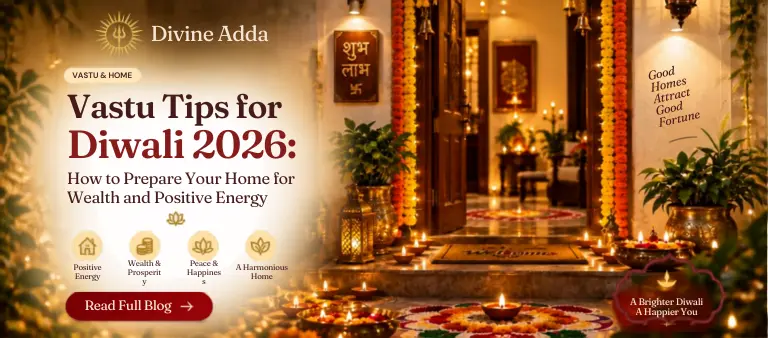
Vastu Tips for Diwali 2026: How to Prepare Your Home for Wealth and Positive Energy
Before you light the diyas, Vastu Shastra has specific advice on where to place them, which direction Lakshmi should face, and what to clear out first. Here's a room-by-room Vastu guide for Diwali 2026
Why Vastu and Diwali are so closely linked
Diwali is built around inviting Goddess Lakshmi — the deity of wealth and abundance — into the home. Vastu Shastra, the traditional Indian science of architecture and space, is fundamentally concerned with how a home's layout and energy either invite or block exactly that kind of prosperity. The two overlap naturally: Diwali gives households a yearly occasion to actively apply Vastu principles, not just decorate. With Diwali 2026 falling on Sunday, 8 November, the days leading up to it are considered the ideal window to make these adjustments.
Start with the main entrance
In Vastu, the main door is considered the point through which a home's energy — and by extension, its prosperity — enters or is blocked. Before Diwali, it's traditionally recommended to repair any broken door hinges, replace burnt-out bulbs near the entrance, and ensure the door opens smoothly without creaking or sticking. A toran (a decorative door hanging, often of mango leaves or marigold) is traditionally placed above the main entrance specifically to welcome positive energy, and rangoli is drawn just outside the threshold for the same reason — both are treated as more than decoration in the Vastu framework.
Clear clutter before you decorate
Vastu treats clutter as stagnant energy — accumulated, unused items are believed to block the free movement of positive energy through a space, regardless of how well the space is otherwise arranged. This is the practical basis for the pre-Diwali deep-cleaning tradition observed in most households: clearing out broken items, unused furniture, and anything gathering dust is considered a prerequisite for any Vastu improvement to actually take effect, not a separate task from it.
Where to place the Lakshmi-Ganesh idols
For the main Diwali puja, Vastu recommends placing the Lakshmi and Ganesh idols in the North or Northeast direction of the room used for worship, since this zone is associated in Vastu with wealth and spiritual energy. The idols are traditionally positioned facing West or the person performing the puja, and Lakshmi is placed to the right of Ganesh — the "right" position, in this context, being determined from the deities' own perspective, not the worshipper's, which is a common point of confusion.
Diyas: direction and placement matter more than quantity
While rows of diyas across the front of a home are the festival's most visible symbol, Vastu attaches specific meaning to where certain diyas are placed:
- A diya at the main entrance is traditionally placed on the right side as you exit the house.
- A diya near the Tulsi plant, if the home has one, is generally placed in the Northeast.
- One diya is traditionally lit and placed in the Southeast corner of the home, since this zone is associated with the fire element (Agni) in Vastu, and lighting a lamp there is considered a way of activating rather than working against that zone's natural energy.
- Diyas are avoided directly under stairs or in bathrooms, both considered inappropriate zones for an active flame in Vastu terms.
Kitchen and Southeast corner
The kitchen itself is a specific focus in Vastu, since it's ideally located in the Southeast corner of a home to align with the fire element. Around Diwali, beyond general cleaning, it's traditionally recommended to fix any leaking taps in or near the kitchen — a leak in this zone is treated in Vastu as a symbol of wealth "leaking away," making a functioning kitchen a wealth-related concern, not just a hygiene one, during this specific window.
Colours and directions inside the home
Vastu also links specific colours to specific directions, which some households use to guide Diwali decor rather than choosing purely by aesthetic preference:
- North — greens and light blues, associated with growth and new opportunity
- Northeast — white or very light shades, associated with spiritual clarity
- South — reds and oranges, associated with energy and fame
- Southwest — earthy tones like brown or terracotta, associated with stability and relationships
What to avoid during the Diwali period
A few things Vastu specifically discourages around this time: leaving the Northeast corner of the home cluttered or heavy with furniture (this zone is treated as the most sensitive to blocked energy), placing mirrors directly facing the main entrance (believed to reflect incoming positive energy back outward rather than letting it settle), and starting the festival with unresolved repairs to broken glass, cracked walls, or non-functioning electrical fittings, all considered forms of the same "stagnant energy" clutter represents.
Vastu as preparation, not superstition alone
None of this is presented in the tradition as guaranteed to produce wealth on its own — Vastu treats these adjustments as removing obstacles to prosperity rather than manufacturing it directly. Read that way, most of the specific Diwali recommendations (fixing what's broken, clearing what's unused, orienting the home's main sparitual focal point deliberately) are also just good, practical preparation for hosting a major household festival — Vastu gives that preparation a specific direction and order to follow, rather than leaving it arbitrary.