Anant Chaturdashi: The Story of King Kaundinya and Lord Vishnu's Endless Form
A queen ties a sacred thread and prospers for fourteen years. Her husband burns it in doubt — and loses everything. The story behind Anant Chaturdashi's Anant Sutra, observed this year on 25 September.
Quick facts
- Deity
- Vishnu, in his Ananta (endless) form
- 2026 date
- Friday, 25 September
- Tithi
- Bhadrapada Shukla Chaturdashi
- Central ritual
- Tying the Anant Sutra (14-knotted thread)
- Coincides with
- Ganesh Visarjan, final day of Ganeshotsav
A festival most people only know as "the last day of Ganpati"
Every year, Anant Chaturdashi gets absorbed into the noise of Ganesh Visarjan — the immersion processions, the drums, the crowds at the riverbank. In 2026, both fall on the same day, Friday, 25 September, which makes it even easier to miss that Anant Chaturdashi is its own festival, dedicated to Lord Vishnu, with its own story, older than the public Ganeshotsav celebrations most people associate with this date.
At the center of it is a simple object — a thread with fourteen knots, called the Anant Sutra — and a story about what happens when faith is tested by doubt.
Sushila finds a thread by the river
The story begins with a sage named Kaundinya, married to a devoted woman named Sushila. One day, while performing rituals by a riverbank, Sushila noticed a group of women wearing a distinctive thread tied around their wrist, performing a puja she didn't recognize. She asked them what it was.
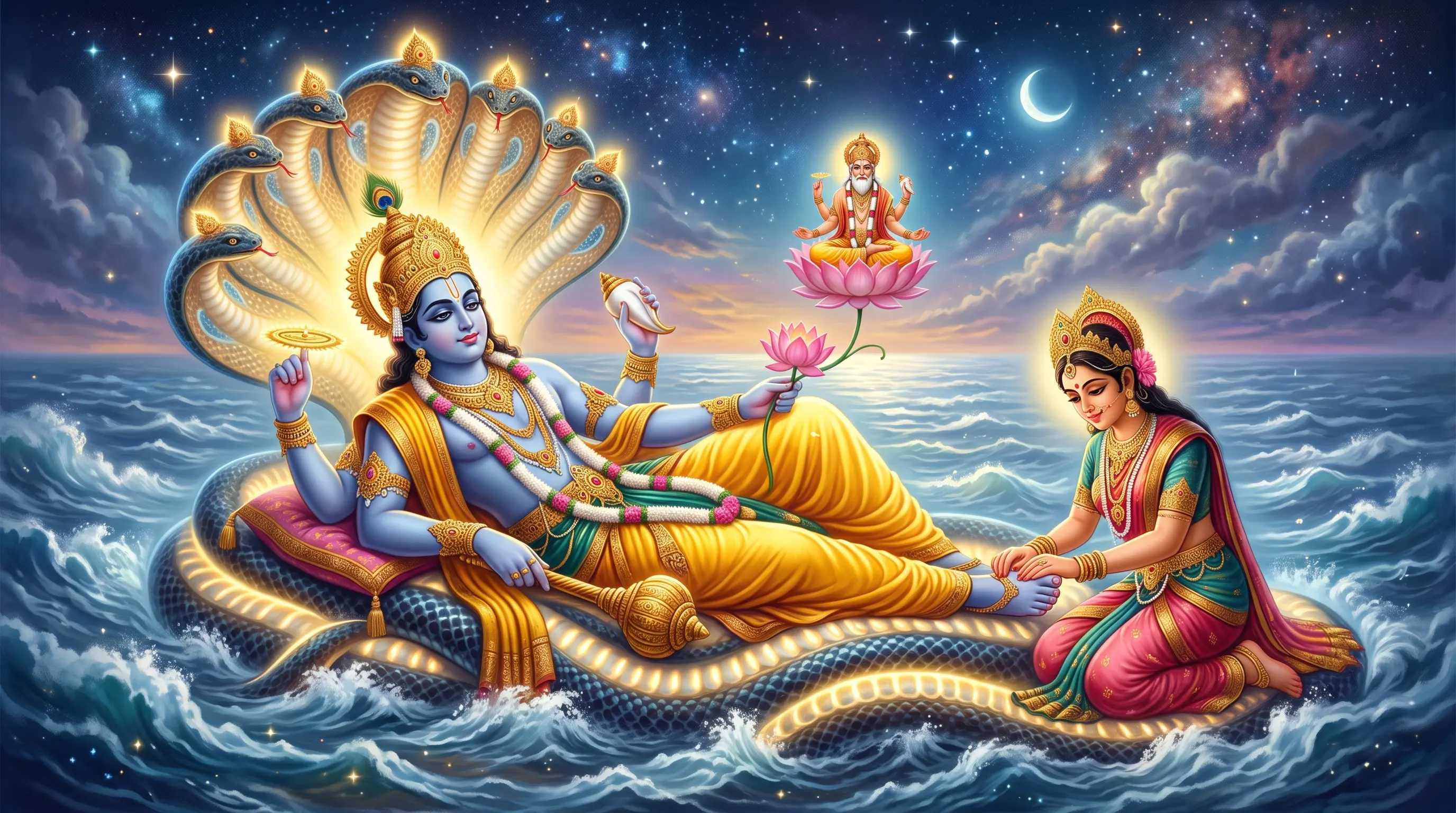
They told her it was the Anant Vrat, a vow dedicated to Lord Vishnu in his Ananta form — the endless, infinite aspect of the god, depicted reclining on the coils of the serpent Shesha in the cosmic ocean. The thread, tied with fourteen knots representing the fourteen worlds of Hindu cosmology, was worn as a mark of the vow. Sushila, moved by what she heard, tied the thread herself and began observing the vrat.
Fourteen years of quiet prosperity
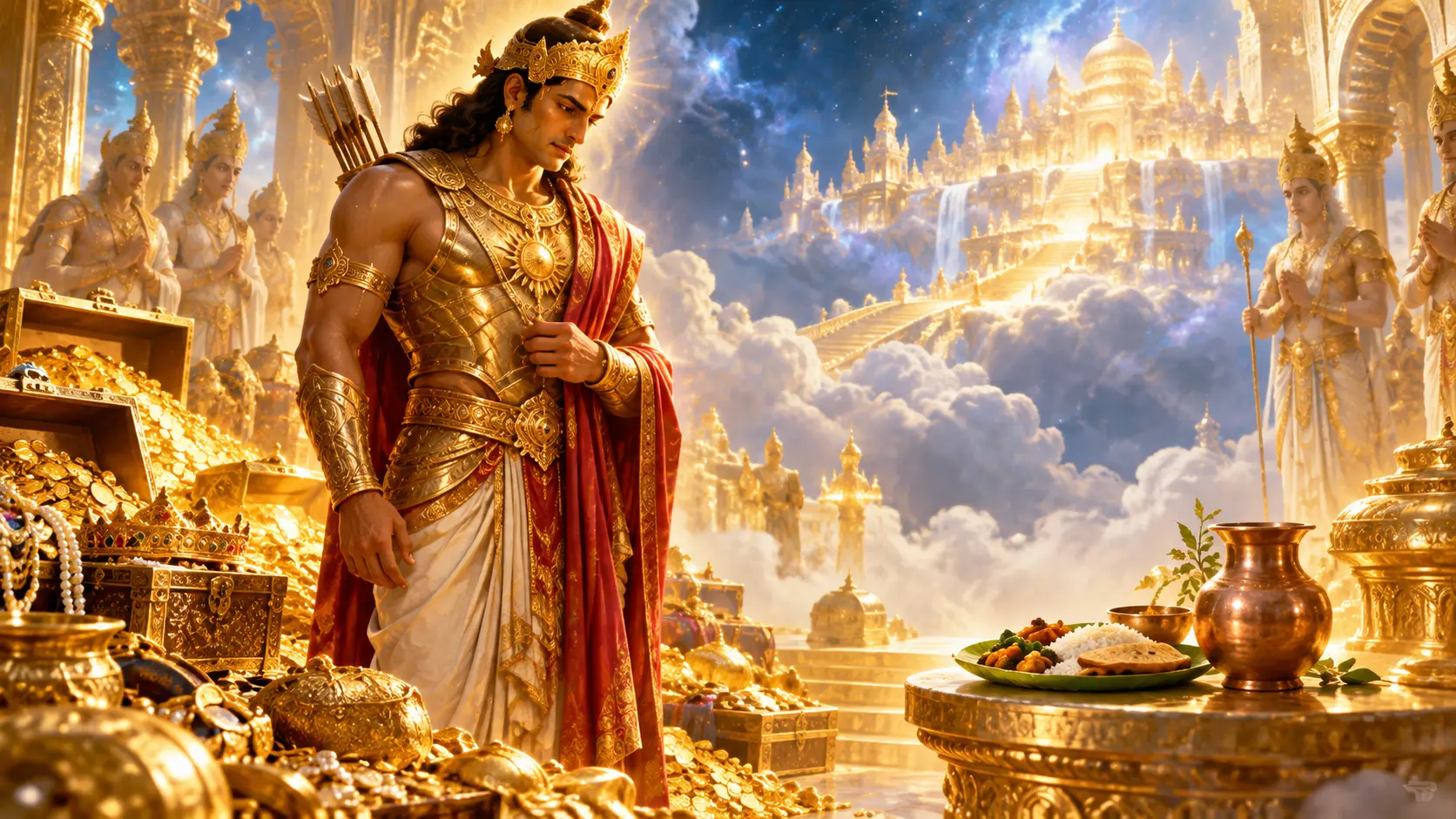
From the day she tied the Anant Sutra, Sushila's household began to flourish. Kaundinya's fortunes improved steadily — his position, his wealth, his standing all grew, year after year, for fourteen years. Sushila never told him the source of this change; she simply continued observing the vrat privately, faithfully, without drawing attention to it.
Eventually, Kaundinya noticed the thread on her wrist and asked about it. When Sushila explained its significance and admitted that their years of prosperity had followed directly from the day she first tied it, Kaundinya reacted with suspicion rather than gratitude. He doubted that a simple thread could be responsible for anything, and — in a moment of irritation — he untied it from her wrist and threw it into a fire.
A fall as steep as the rise
Almost immediately, Kaundinya's fortunes reversed. His wealth disappeared, his position collapsed, and the family that had prospered for fourteen years found itself destitute within a short span. Kaundinya, now desperate and searching for a way to reverse the disaster he'd caused, set out into the forest to find some explanation — and, if possible, a way back.
What follows in the traditional telling is a long, difficult journey: Kaundinya wanders through the wilderness, encountering a series of strange figures — a tree, a cow, a group of monkeys — from each of whom he seeks answers, and to each of whom, in some versions of the story, he shows disrespect out of his own frustration, worsening his situation further before he learns anything useful.
An old Brahmin who is really Vishnu
Exhausted and humbled, Kaundinya eventually encounters an elderly Brahmin who recognizes his suffering and asks what's wrong. Kaundinya recounts the whole story — the thread, his doubt, the fire, the collapse that followed. The Brahmin listens and then reveals himself to be Lord Vishnu himself, present all along in this humble disguise.
Vishnu tells Kaundinya plainly: it wasn't the thread itself that carried the power, but the faith and devotion behind tying it — and by destroying the thread out of doubt, Kaundinya had rejected that devotion, not just an object. Vishnu then instructs him in the full Anant Vrat — how to observe it properly, with sincerity, for fourteen years, just as Sushila had.
Restoration, and the point of the story
Kaundinya returns home, tells Sushila everything, and together they resume the vrat with proper devotion. Over time, their prosperity is restored, and the story closes with the family more secure than before — not because the ritual itself was magic, but because the doubt that had broken it was finally resolved.
The Anant Vrat Katha isn't really a story about a thread's supernatural power. It's a story about what happens when a shared practice — something one partner does quietly and consistently — gets dismissed by the other simply because its mechanism isn't visible or provable. Sushila's fourteen years of faith cost her nothing to maintain; Kaundinya's few seconds of doubt cost the family everything they had. The vrat's restoration isn't just ritual repair — it's Kaundinya relearning to trust something he can't fully explain.
Why this falls on Chaturdashi, and why it overlaps with Ganesh Visarjan
Anant Chaturdashi is observed on the fourteenth day (Chaturdashi) of the bright fortnight of Bhadrapada — the same date, by coincidence of the lunar calendar, on which the ten-day Ganeshotsav customarily concludes with Ganesh Visarjan. The two festivals are unrelated in origin: one honors Vishnu's Ananta form and predates the large-scale public Ganeshotsav celebrations by a long tradition of its own, while the other marks the close of Ganesha's ten-day stay. Because they share a date, many households now observe both — tying the Anant Sutra and performing Ganesh Visarjan on the same day, in 2026 falling on Friday, 25 September.
Timeline
Day 1 of the vrat
Sushila learns of the Anant Vrat
She ties the Anant Sutra by the riverbank after seeing other women observe it
Year 14
Kaundinya burns the thread
Doubting its power, he destroys the source of the family's prosperity
Journey in the forest
Kaundinya seeks answers
He wanders, encountering a tree, a cow and monkeys before finding a Brahmin
Revelation
The Brahmin reveals himself as Vishnu
He explains that devotion, not the object itself, carried the vrat's power
25 September 2026
Anant Chaturdashi
The vrat and Ganesh Visarjan are observed on the same date this year
Sources & further reading
- Skanda Purana / Bhavishya Purana, Anant Vrat Katha
DivineAdda Editorial
Scripture research and editorial team
Last updated 19 September 2026